Arms and Armour
Gheluvelt Plateau actions, July–August 1917
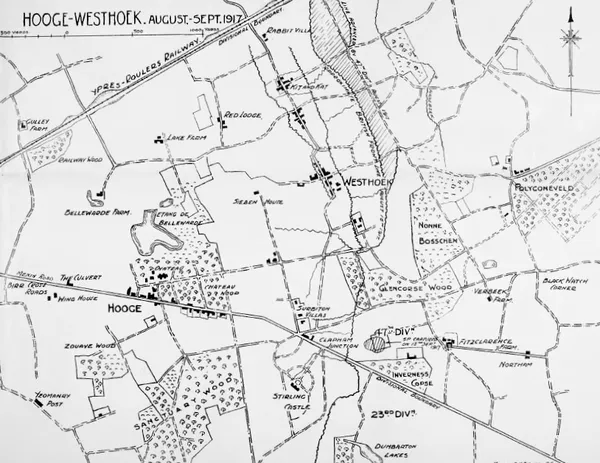
The Gheluvelt Plateau actions, July–August 1917 took place from 31 July to 27 August, during the Third Battle of Ypres (31 July – 10 November 1917) in Belgium, in the First World War. The British Fifth Army and the German 4th Army fought for possession of the plateau at the highest part of the ridges to the south-east, east and north-east of Ypres in West Flanders. The 4th Army had been building defensive positions in the Ypres Salient since 1915 and the Gheluvelt Plateau was the most fortified section of the front. The Fifth Army had made the plateau its main objective during the Battle of Pilckem Ridge (31 July – 2 August) but the II Corps advance was contained short of its objectives and German counter-attacks later recaptured some ground. The ground had been churned by artillery-fire and beginning late on 31 July, torrential rains lasted until 5 August, turning the ground into a sea of mud and flooded shell craters. An attack by II Corps on 2 August, postponed to 10 August, led to the Capture of Westhoek but Inverness Copse, Glencorse Wood and Nonne Bosschen were re-captured by German counter-attacks. The German defensive success was costly even with new tactics and began to concern German commanders. In a dry spell, the Fifth Army attacked again at the Battle of Langemarck (16–18 August) but II Corps was again repulsed by counter-attacks of the German ground-holding divisions and their supporting Eingreif (specialist counter-attack) divisions. The Royal Flying Corps flew more battlefield reconnaissance and ground attack sorties but a German hasty counter-attack (Gegenstoß) overran a brigade of the 56th (1/1st London) Division, leaving British troops further north outflanked, forcing them to retreat. On 22 August, the 14th (Light) Division captured Inverness Copse and then lost it to a German methodical counter-attack (Gegenangriff) on 24 August. A tank–infantry attack failed on 27 August, when the tanks bogged down and another attempt was cancelled on 31 August. The sodden ground hampered all movement, made tank operations almost impossible and smothered shell explosions. Low cloud and fog obstructed communication between the front line and rear, impeding liaison between British artillery and their observation aircraft.
Also on this shelf
Kenilworth Castle.
Henry Metcalfe (military officer).
See also
Uncatalogued shelfText from Wikipedia; plate via Wikimedia Commons. Text CC BY-SA 4.0; plate freely licensed (see Commons). Source record. Images and catalogue data are reproduced from open-access collections.