Arms and Armour
Hermes
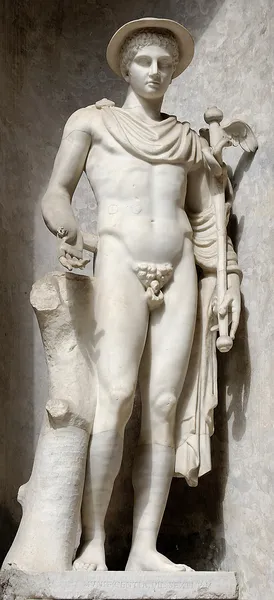
Hermes (; Ancient Greek: Ἑρμῆς) is an Olympian deity in ancient Greek religion and mythology considered the herald of the gods. He is also widely considered the protector of human heralds, travelers, thieves, merchants, and orators. He is able to move quickly and freely between the worlds of the mortal and the divine aided by his winged sandals. Hermes plays the role of the psychopomp or "soul guide"—a conductor of souls into the afterlife. In myth, Hermes functions as the emissary and messenger of the gods, and is often presented as the son of Zeus and Maia, the Pleiad. He is regarded as "the divine trickster", about which the Homeric Hymn to Hermes offers the most well-known account. Hermes's attributes and symbols include the herma, the rooster, the tortoise, satchel or pouch, talaria (winged sandals), and winged helmet or simple petasos, as well as the palm tree, goat, the number four, several kinds of fish, and incense. However, his main symbol is the caduceus, a winged staff intertwined with two snakes copulating and carvings of the other gods. In Roman mythology and religion many of Hermes's characteristics belong to Mercury, a name derived from the Latin merx, meaning "merchandise", and the origin of the words "merchant" and "commerce."
Also on this shelf
Anglo-Saxon warfare.
44th Infantry Division (Wehrmacht).
See also
Uncatalogued shelfText from Wikipedia; plate via Wikimedia Commons. Text CC BY-SA 4.0; plate freely licensed (see Commons). Source record. Images and catalogue data are reproduced from open-access collections.