Arms and Armour
Edinburgh town walls
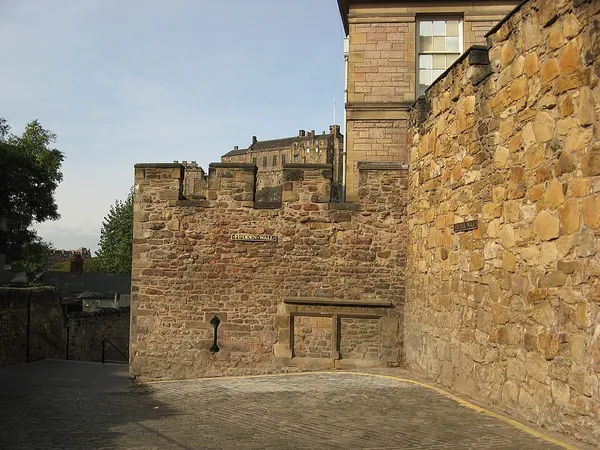
There have been several town walls around Edinburgh, Scotland, since the 12th century. Some form of wall probably existed from the foundation of the royal burgh in around 1125, though the first building is recorded in the mid-15th century, when the King's Wall was constructed. In the 16th century the more extensive Flodden Wall was erected, following the Scots' defeat at the Battle of Flodden in 1513. This was extended by the Telfer Wall in the early 17th century. The walls had a number of gates, known as ports, the most important being the Netherbow Port, which stood halfway down what is now the Royal Mile. This gave access from the Canongate which was, at that time, a separate burgh. The walls never proved very successful as defensive structures, and were easily breached on more than one occasion. They served more as a means of controlling trade and taxing goods, and as a deterrent to smugglers. By the mid 18th century, the walls had outlived both their defensive and trade purposes, and demolition of sections of the wall began. The Netherbow Port was pulled down in 1764, and demolition continued into the 19th century. Today, a number of sections of the three successive walls survive, although none of the ports remain.
Also on this shelf
Cataphract.
George Augustus Eliott, 1st Baron Heathfield.
See also
Uncatalogued shelfText from Wikipedia; plate via Wikimedia Commons. Text CC BY-SA 4.0; plate freely licensed (see Commons). Source record. Images and catalogue data are reproduced from open-access collections.