Arms and Armour
Chaturanga
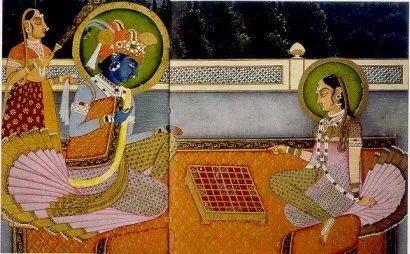
Chaturanga (Sanskrit: चतुरङ्ग, IAST: caturaṅga, pronounced [tɕɐt̪uˈɾɐŋɡɐ]) is an ancient Indian strategy board game. It is first known from India around the seventh century CE. While there is some uncertainty, the prevailing view among chess historians is that chaturanga is the common ancestor of the board games chess, xiangqi (Chinese), janggi (Korean), shogi (Japanese), sittuyin (Burmese), makruk (Thai), ouk chatrang (Cambodian) and modern Indian chess. It was adopted as chatrang (shatranj) in Sassanid Persia, which in turn was the form of chess brought to late-medieval Europe. Not all the rules of chaturanga are known with certainty. Chess historians suppose that the game had rules similar to those of its successor, shatranj. In particular, there is uncertainty as to the moves of the gaja (elephant).
Also on this shelf
Havana Harbor.
Arthur Haselrig.
See also
Uncatalogued shelfText from Wikipedia; plate via Wikimedia Commons. Text CC BY-SA 4.0; plate freely licensed (see Commons). Source record. Images and catalogue data are reproduced from open-access collections.