Architecture
Glass Pavilion
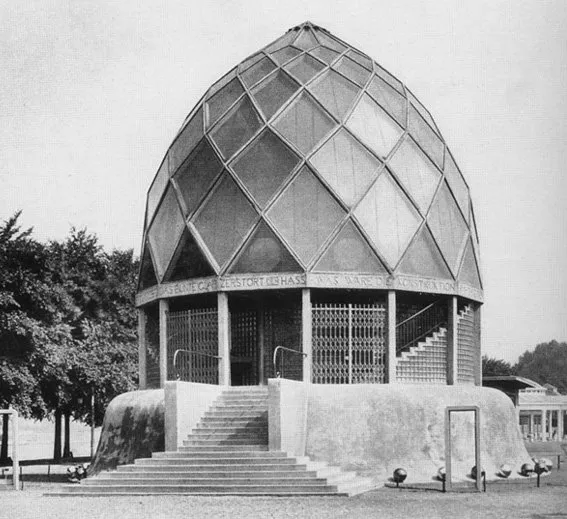
The Glass Pavilion, designed by Bruno Taut and built in 1914, was a prismatic glass dome structure at the Cologne Deutscher Werkbund Exhibition. The structure was a brightly colored landmark of the exhibition, constructed using concrete and glass. The dome had a double glass outer layer with colored glass prisms on the inside and reflective glass on the outside. The facade had inlaid colored glass plates that acted as mirrors. Taut described his "little temple of beauty" as "reflections of light whose colors began at the base with a dark blue and rose up through moss green and golden yellow to culminate at the top in a luminous pale yellow." The Glass Pavilion is Taut's single best-known architectural achievement. He built it for the German glass industry association specifically for the 1914 exhibition. They financed the structure that was considered a house of art. The purpose of the building was to demonstrate the potential of different types of glass for architecture. It also indicated how the material might be used to orchestrate human emotions and assist in the construction of a spiritual utopia. The structure was made at the time when expressionism was most fashionable in Germany, and it is sometimes referred to as an expressionist-style building. The only known photographs of the building were made in 1914, but these black-and-white images are only marginal representations of the actualities of the work. The building was destroyed soon after the exhibition since it was an exhibition building only and not built for practical use. The Glass Pavilion was a pineapple-shaped multi-faceted polygonal designed rhombic structure. It had a fourteen-sided base constructed of thick glass bricks used for the exterior walls devoid of rectangles. Each part of the cupola was designed to recall the complex geometry of nature. The Pavilion structure was on a concrete plinth, the entrance reached by two flights of steps (one on either side of the building), which gave the pavilion a temple-like quality. Taut's Glass Pavilion was the first building of importance made of glass bricks. There were glass-treaded metal staircases inside that led to the upper projection room that showed a kaleidoscope of colors.
Also on this shelf
Giovanni delle Bande Nere.
Benito Mussolini.
See also
Uncatalogued shelfText from Wikipedia; plate via Wikimedia Commons. Text CC BY-SA 4.0; plate freely licensed (see Commons). Source record. Images and catalogue data are reproduced from open-access collections.