Architecture
Hanover school of architecture
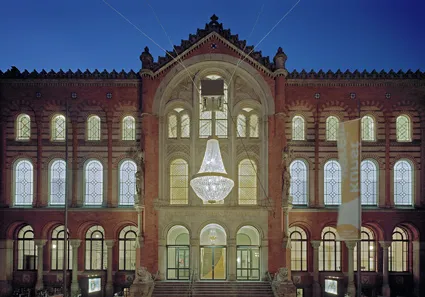
The Hanoverian school of architecture or Hanover School is a school of architecture that was popular in Northern Germany in the second half of the 19th century, characterized by a move away from classicism and neo-Baroque and distinguished by a turn towards the neo-Gothic. Its founder, the architect Conrad Wilhelm Hase, designed almost 80 new church buildings and over 60 civil buildings alone. In addition, Hase taught for 45 years at the Polytechnic University in Hanover and trained around 1000 full-time architects, many of whom adopted his style principles. The expanding industrialization of nineteenth-century Germany favored the development of the Hanover School, especially in urban areas, where a rapidly-growing population led to a great demand for new homes, schools and hospitals. The expansion of the railway network required new structures such as station and company buildings, and emerging industrial corporations built impressive factory structures that reflected their economic importance. Hanover itself saw the construction of numerous large municipal churches, schools, and factories as well as several thousand residences between the 1850s and the beginning of the 20th century. Stylistically, these buildings were characterized by their unplastered brick facades, which were perceived as "honest." Especially for factory buildings, it was already possible to recognize its internal function by the outer shape of a building. Exterior ornament used a number of design elements: stepped gables with finials, carved stone, and decoratively set bricks with a glazed surface derived from medieval church buildings. For a long time after the Second World War, during which most large German cities were heavily bombed, the remaining buildings, especially in Hanover, garnered little interest in monument preservation. Large-scale transformation measures and the conversion of Hanover into a car-friendly city led to numerous demolitions. The term "Hanover School of Architecture" probably first appeared in 1882 with Theodor Unger. At the time, however, the term also referred to the previously popular Rundbogenstil ("round-arched style" or Romanesque revival style) and the buildings shaped by Hase's influence. It was only later on that only the buildings designed according to Hase's teachings were counted as the "classic" Hanover School.
Also on this shelf
Renaissance Revival architecture.
Elias of Dereham.
See also
Uncatalogued shelfText from Wikipedia; plate via Wikimedia Commons. Text CC BY-SA 4.0; plate freely licensed (see Commons). Source record. Images and catalogue data are reproduced from open-access collections.