Architecture
Elgin Cathedral
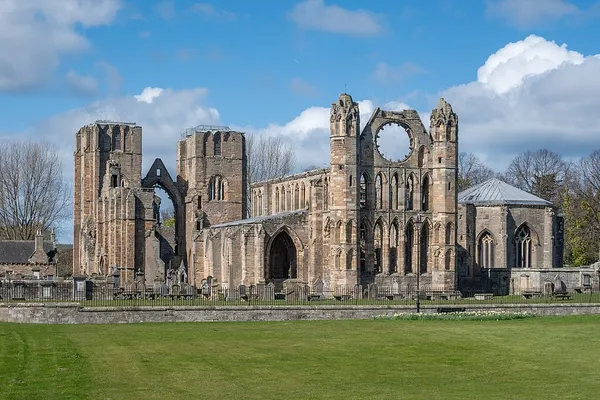
Elgin Cathedral, also known as the Lantern of the North (Scots: Lantern o the North), is a historic ruin in Elgin, Moray, in northeast Scotland. Established in 1224 on land granted by King Alexander II, it was the seat of the bishops of Moray. It replaced the cathedral at Spynie, located 3 kilometres (2 mi) to the north, and was served by a small chapter of eight clerics. By 1226, the expanding cathedral was staffed with 18 canons, a number that increased to 23 by 1242. Even then, the cathedral was regarded as a fine example of contemporary architecture, described as the "ornament of the realm" and the "glory of the kingdom". It was also the second-largest cathedral in Scotland, after St Andrews. It experienced major building phases. The first followed an extensive fire in 1270 and then again after an incendiary attack in 1390 by Alexander Stewart, Earl of Buchan, later known as the "Wolf of Badenoch". The resulting structure featured a massive west front with twin towers and an impressive choir and presbytery, which also integrated an octagonal chapter house. By 1560, the year of the Scottish Reformation, the canonry reached its zenith with the number rising to 25. However, this also marked the beginning of the cathedral's decline when its congregation was moved to the parish church of St Giles. In 1567, the Privy Council ordered the removal of the lead that covered the roof to help fund the army. This exposed the interior to the elements. Significant structural failures followed, including the collapse of the choir roof in 1637 and the collapse of the central tower in 1711, destroying most of the nave. Major conservation and refurbishment work, begun in the early 19th century, continued until the late 20th century and has been followed by ongoing stabilisation work. Today, Elgin Cathedral is a scheduled monument managed by Historic Environment Scotland. Despite its ruined state, much of the 13th-century west front and the 15th-century chapter house remain intact. The site is a major visitor attraction and contains extensive collections of medieval stone carvings and a 9th-century Pictish cross-slab found nearby.
Also on this shelf
Cathedral of the Holy Trinity (Quebec).
Fontana di Piazza Colonna.
See also
Uncatalogued shelfText from Wikipedia; plate via Wikimedia Commons. Text CC BY-SA 4.0; plate freely licensed (see Commons). Source record. Images and catalogue data are reproduced from open-access collections.