Architecture
Haludovo Palace Hotel
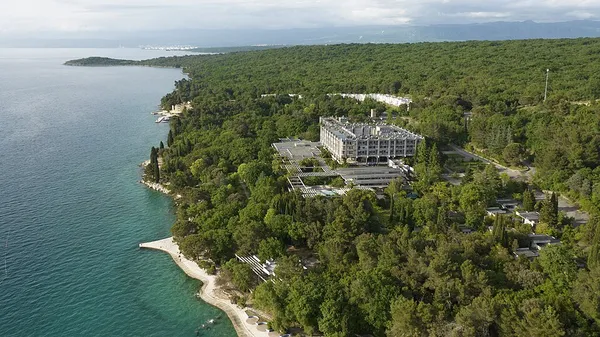
The Haludovo Palace Hotel is an abandoned resort hotel near Malinska on the island of Krk, Croatia. It formed the architectural and social centre of Haludovo, a large tourist resort designed by Croatian architect Boris Magaš and constructed between 1969 and 1972 during the rapid expansion of tourism on the Yugoslav Adriatic. Covering approximately 25 hectares (62 acres), Haludovo was conceived as a self-contained tourist settlement rather than a single hotel. In addition to the Palace, it included Hotel Tamaris, groups of atrium and two-storey villas, the coastal Fishermen's Village, and extensive sports, leisure and service facilities. The first phase was designed for approximately 1,650 guests, while the original planning concept envisaged an eventual capacity of about 5,000 beds. Haludovo gained international attention in 1972 through a short-lived partnership between the Rijeka-based Yugoslav trading company Brodokomerc and American publisher Bob Guccione, founder of Penthouse. Guccione established the Penthouse Adriatic Club within the Palace, including a casino intended primarily for foreign visitors. The partnership ended the following year amid financial difficulties, but Haludovo continued operating as a conventional holiday resort throughout the 1970s and 1980s. After the outbreak of the Croatian War of Independence in 1991, the resort lost much of its tourist market and was temporarily used to accommodate refugees. It was privatised during the 1990s and subsequently passed through several ownership structures. The Palace ceased hotel operations around New Year 2002 and has since remained abandoned. Architectural historians regard Haludovo as one of Magaš's most significant works and an important example of Yugoslav tourist architecture. Although fundamentally modernist, its use of historical urban analogies, varied architectural typologies and expressive forms has been interpreted as anticipating elements of postmodern architecture in Croatia.
Also on this shelf
Embassy of the Philippines, Tokyo.
Art Nouveau in Brussels.
See also
Uncatalogued shelfText from Wikipedia; plate via Wikimedia Commons. Text CC BY-SA 4.0; plate freely licensed (see Commons). Source record. Images and catalogue data are reproduced from open-access collections.