Architecture
Ionic order
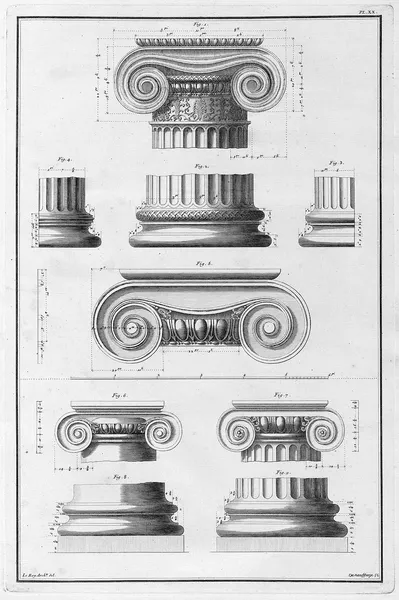
The Ionic order (Latin: Ordo Ionicus) is one of the three canonic orders of classical architecture, the other two being the Doric and the Corinthian. There are two other orders, developed by the Romans: the Tuscan (a plainer Doric), and the rich variant of Corinthian called the Composite order. Of the three classical canonic orders, the Corinthian order has the narrowest columns, followed by the Ionic order, with the Doric order having the widest columns. The Ionic capital is characterized by the use of volutes. Ionic columns normally stand on a base which separates the shaft of the column from the stylobate or platform while the cap is usually enriched with egg-and-dart. The ancient architect and architectural historian Vitruvius associates the Ionic with feminine proportions (and the Doric with masculine ones).
Also on this shelf
Alexander Nevsky Cathedral, Tiflis.
Cathedral of Saint Mary, Pattom.
See also
Uncatalogued shelfText from Wikipedia; plate via Wikimedia Commons. Text CC BY-SA 4.0; plate freely licensed (see Commons). Source record. Images and catalogue data are reproduced from open-access collections.