Architecture
Erasmus House
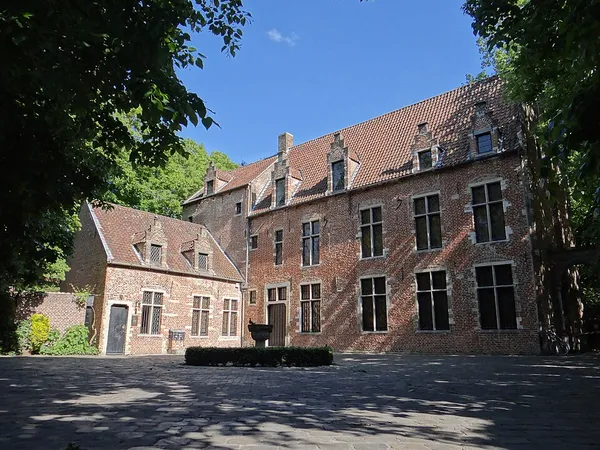
The Erasmus House (French: Maison d'Érasme; Dutch: Erasmushuis), also known as the Erasmus House Museum (French: Musée de la Maison d'Érasme; Dutch: Erasmushuismuseum), and formerly as the De Swaene chapter house, is a historic house museum in Anderlecht, a municipality of Brussels, Belgium, devoted to the Dutch humanist writer and theologian Erasmus of Rotterdam. The house, of late Gothic or early Renaissance style, was built between 1460 and 1515 under the tutelage of Peter Wijchmans, canon and schoolmaster of the chapter of Anderlecht, and a friend of Erasmus. Erasmus stayed there for five months, from May to October 1521, working on his translation of his Novum Testamentum from Greek into Latin. The house was converted to a museum in 1931. Its garden is divided into two sections, both inspired by Erasmus's spirit: one through art and philosophy and the other, designed by René Pechère, through typical 16th-century medicinal plants. The complex was designated a historic monument in 1938. The Erasmus House stands close to the 14th-century Collegiate Church of St. Peter and St. Guido, a Gothic church dedicated to Saint Guy of Anderlecht, who was buried there in the 11th century, as well as the old beguinage of Anderlecht, a late medieval lay convent, now a museum dedicated to religious community life. Both institutions are now managed jointly as the Erasmus House & Beguinage Museums (French: Musées Maison d'Erasme & Béguinage; Dutch: Erasmushuis & Begijnhofmusea).
Also on this shelf
Ferrara Cathedral.
De architectura.
See also
Uncatalogued shelfText from Wikipedia; plate via Wikimedia Commons. Text CC BY-SA 4.0; plate freely licensed (see Commons). Source record. Images and catalogue data are reproduced from open-access collections.