Architecture
Baroque architecture in Lviv
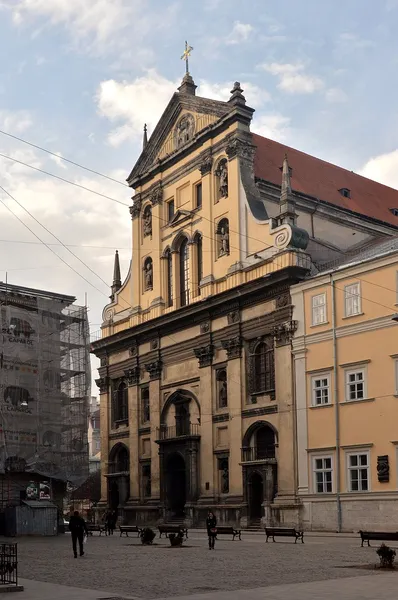
Baroque architecture in Lviv refers to the architectural period of the 17th and 18th centuries in Lviv. Its appearance coincided with the spread of the style in the territories of the Kingdom of Poland, succeeding the Renaissance architecture. Baroque architecture in Lviv makes up a part of the larger Ukrainian Baroque artistic movement. During the second half of the 16th century and until the middle of the 17th century, Lviv's economic and cultural life has noticeably revived. Development spread to the south, east, and west of the city center. Starting from the second half of the 17th century, the role of the bourgeoisie in construction, and public life in general, gradually declined, the initiative was taken over by secular magnates and catholic orders, who became the main customers of architects and artists. The Baroque style was introduced in the city at the beginning of the 17th century with the construction of the Jesuit Saints Peter and Paul Garrison Church. The church was designed by Giacomo Briano and modeled after the Church of the Gesù in Rome. It is considered to be the first Baroque church in modern Ukraine and one of the first in the Polish-Lithuanian Commonwealth. In the same century, the Baroque complexes of the Discalced Carmelite, Magdalene, and Lazarus monasteries were constructed in Lviv. Baroque has gradually become the dominant style at the end of the 17th century, and reached its peak in the middle of the 18th century.
Also on this shelf
Architecture in Kievan Rus'.
Albi Cathedral.
See also
Uncatalogued shelfText from Wikipedia; plate via Wikimedia Commons. Text CC BY-SA 4.0; plate freely licensed (see Commons). Source record. Images and catalogue data are reproduced from open-access collections.