Architecture
History of Hungary
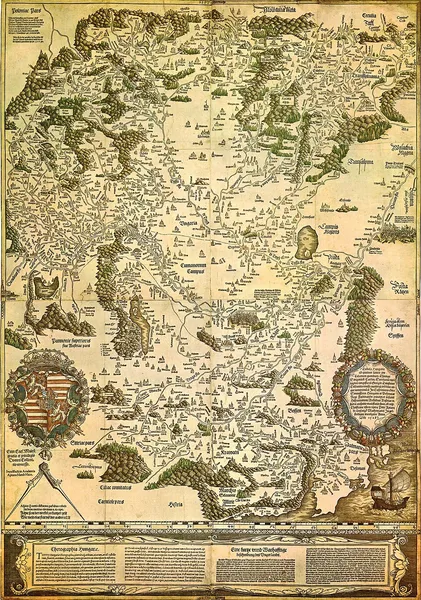
Hungary in its modern (post-1946) borders roughly corresponds to the Great Hungarian Plain (the Carpathian Basin) in Central Europe. During the Iron Age, it was located at the crossroads between the cultural spheres of Scythian tribes (such as Agathyrsi, Cimmerians), the Celtic tribes (such as the Scordisci, Boii and Veneti), Dalmatian tribes (such as the Dalmatae, Histri and Liburni) and the Germanic tribes (such as the Lugii, Marcomanni). In 44 BC, the Sarmatians, Iazyges moved into the Great Hungarian Plain. In 8 AD, the western part of the territory (the so-called Transdanubia) of modern Hungary formed part of Pannonia, a province of the Roman Empire. Roman control collapsed with the Hunnic invasions of 370–410, the Huns created a significant empire based in present-day Hungary. In 453 they reached the height of their expansion under Attila the Hun. After the death of Attila, the empire collapsed in 455, and Pannonia became part of the Ostrogothic Kingdom. The western part of the Carpathian Basin was occupied by the Longobards and the eastern part by the Gepids. In 567, the Avars occupied the territory ruled by the Gepids. In 568, the Longobards moved to Italy from Transdanubia, and the Avars also occupied that territory, Khagan Bayan I established the Avar Khaganate. The Avars were defeated by the Franks and Bulgars, and their steppe-empire ended around 822. The Hungarians took possession of the Carpathian Basin between 862 and 895, and the Principality of Hungary was established in the late 9th century by Álmos and his son Árpád through the conquest of the Carpathian Basin, the Hungarians secured the territory by the Battle of Pressburg in 907. The Christian Kingdom of Hungary was established in 1000 under King Saint Stephen, ruled by the Árpád dynasty for the following three centuries. In the high medieval period, the kingdom expanded to the Adriatic coast and entered a personal union with Croatia in 1102. In 1241, Hungary was invaded by the Mongols under Batu Khan. The medieval Kingdom of Hungary was a European power, reaching its height in the 14th-15th century. Hungary bore the brunt of the Ottoman wars in Europe during the 15th century.
Also on this shelf
Giuseppe Mengoni.
Churrigueresque.
See also
Uncatalogued shelfText from Wikipedia; plate via Wikimedia Commons. Text CC BY-SA 4.0; plate freely licensed (see Commons). Source record. Images and catalogue data are reproduced from open-access collections.