Architecture
Boom style architecture
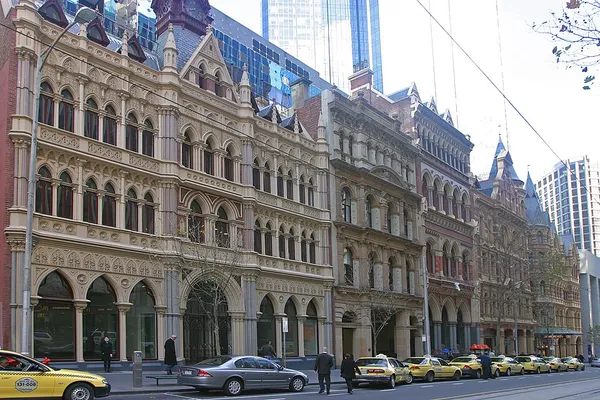
Boom style (more often termed "Late Victorian" architecture elsewhere) is a term used to describe the architecture of Melbourne from the land boom period (1883–1891). Boom style buildings were often distinguished by their lavish ornament. A massive property bubble created wildly speculative values for land and excessive borrowing which was initially aided by generational wealth from the Victorian gold rush. Additional hype generated from the city's growing reputation as a boom town, including being labelled 'Marvellous Melbourne' by George Augustus Sala in 1885, fuelled one of the largest speculative construction periods seen in the southern hemisphere. Owners of residential and commercial property, confident that ever increasing prices would exceed their debts, would often engage architects to create exuberant designs in exotic styles that signified extreme wealth, something fashionable during the 1880s. These contrasted markedly with the much more restrained Georgian and Renaissance Revival and styles of previous construction periods. Its influence in government building, typically more fiscally conservative, was most felt in the educational buildings of the Public Works Department which followed the lead of the prestigious private schools. However at the end of the boom in 1889 prices soared so high that properties pushed skyward to maximise the value of land which was itself excessively overvalued. Borrowings far exceeded the value of the buildings and most of the Land Boomers ended in bankruptcy with most of the cost of construction never recovered, which had a ripple effect which by the early 1890s had crippled the Victorian economy. Some boom style buildings remained incomplete into the 1890s due to the crash and were shortlived due to their impracticality. For a period of time the phrase was used derogatively during a period when the style was "on the nose" due to association with bad debts and corruption, and as further justification for their demolition.
Also on this shelf
Hyōgo Prefectural Museum of Art.
Château de Saint-Germain-en-Laye.
See also
Uncatalogued shelfText from Wikipedia; plate via Wikimedia Commons. Text CC BY-SA 4.0; plate freely licensed (see Commons). Source record. Images and catalogue data are reproduced from open-access collections.