Architecture
Economic history of Portugal
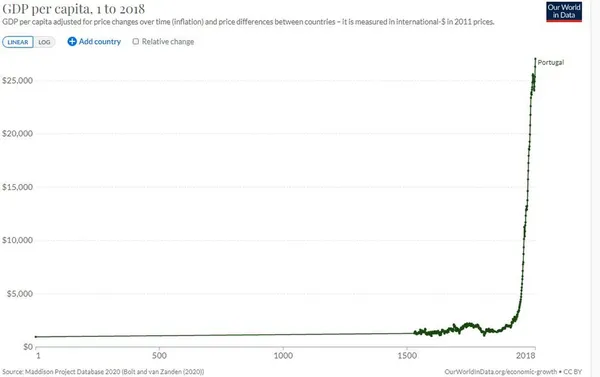
The economic history of Portugal covers the development of the economy throughout the course of Portuguese history. It has its roots prior to nationality, when Roman occupation developed a thriving economy in Hispania, in the provinces of Lusitania and Gallaecia, as producers and exporters to the Roman Empire. This continued under the Visigoths and then Al-Andalus Moorish rule, until the Kingdom of Portugal was established in 1139. With the end of Portuguese reconquista and integration in the European Middle Age economy, the Portuguese were at the forefront of maritime exploration of the Age of Discovery, expanding to become the first global empire. Portugal then became the world's main economic power during the Renaissance, introducing most of Africa and the East to European society, and establishing a multi-continental trading system extending from Japan to Brazil. In 1822, Portugal lost its main overseas territory, Brazil. The transition from absolutism to a parliamentary monarchy involved a devastating Civil War from 1828 to 1834. The governments of the constitutional monarchy were not able to truly industrialise and modernise the country; by the dawn of the twentieth century, Portugal had a GDP per capita of 40% of the Western European average and an illiteracy rate of 74%. Portuguese territorial claims in Africa were challenged during the Scramble for Africa. Political chaos and economic problems endured from the last years of the monarchy to the first Republic of 1910–1926, which led to the installing of a national dictatorship in 1926. While Finance Minister António de Oliveira Salazar managed to discipline the Portuguese public finances, it evolved into a single-party corporative regime in the early 1930s—the Estado Novo—whose first three decades were also marked by a relative stagnation and underdevelopment; as such, by 1960 the Portuguese GDP per capita was only 38% of the EC-12 average. Starting in the early 1960s, Portugal entered in a period of robust economic growth and structural modernisation, owing to a liberalisation of the economy. As an expression of such economic opening, in 1960 the country was one of the EFTA founding member states. Yearly growth rates sometimes with two digits, allowed the Portuguese GDP per capita to reach 56% of the EC-12 average by 1973.
Also on this shelf
Architecture of Seattle.
Farouk of Egypt.
See also
- ▸Boots Factory Site
- ▸Anthony Woodville, 2nd Earl Rivers
- ▸Cathedral Church of St. Paul (Burlington, Vermont)
Text from Wikipedia; plate via Wikimedia Commons. Text CC BY-SA 4.0; plate freely licensed (see Commons). Source record. Images and catalogue data are reproduced from open-access collections.