Architecture
Early skyscrapers
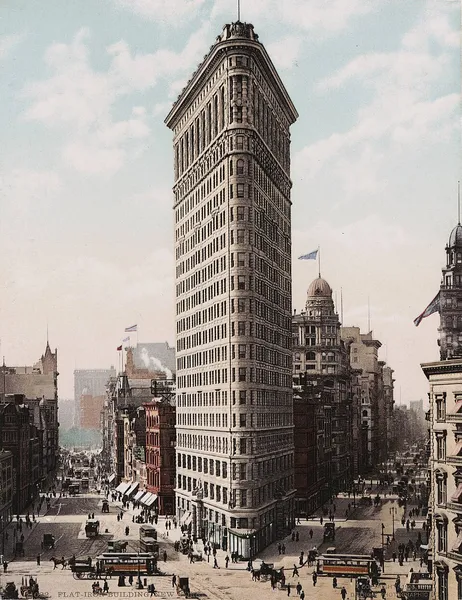
The earliest stage of skyscraper design encompasses buildings built between 1884 and 1945, predominantly in American cities, especially New York and Chicago. Cities in the United States were traditionally made up of low-rise buildings, but significant economic growth after the American Civil War and increasingly intensive use of urban land encouraged the development of taller buildings beginning in the 1870s. Technological improvements enabled the construction of fireproofed iron-framed structures with deep foundations, equipped with new inventions such as the elevator and electric lighting. These made it both technically and commercially viable to build a new class of taller buildings, the first of which, Chicago's 138-foot (42 m) tall Home Insurance Building, opened in 1885. Their numbers grew rapidly, and by 1888 they were being labelled "skyscrapers". Chicago initially led the way in skyscraper design, with many constructed in the center of its financial district during the late 1880s and early 1890s. Sometimes termed the products of the Chicago school of architecture, these skyscrapers attempted to balance aesthetic concerns with practical commercial design, producing large, square palazzo-styled buildings hosting shops and restaurants on the ground level and containing rentable offices on the upper floors. In contrast, New York's skyscrapers were frequently narrower towers which, more eclectic in style, were often criticized for their lack of elegance. In 1892, Chicago banned the construction of new skyscrapers taller than 150 feet (46 m), leaving the development of taller buildings to New York. A new wave of skyscraper construction emerged in the first decade of the 20th century. The demand for new office space to hold the expanding workforce of white-collar staff in the U.S. continued to grow. Engineering developments made it easier to build and live in yet taller buildings. Chicago built new skyscrapers in its existing style, while New York experimented further with tower design. Iconic buildings such as the Flatiron were followed by the 612-foot (187 m) tall Singer Tower, the 700-foot (210 m) Metropolitan Life Insurance Company Tower, and the 792-foot (241 m) Woolworth Building.
Also on this shelf
Mystki Palace.
Acireale Cathedral.
See also
Uncatalogued shelfText from Wikipedia; plate via Wikimedia Commons. Text CC BY-SA 4.0; plate freely licensed (see Commons). Source record. Images and catalogue data are reproduced from open-access collections.