Architecture
Ely Cathedral
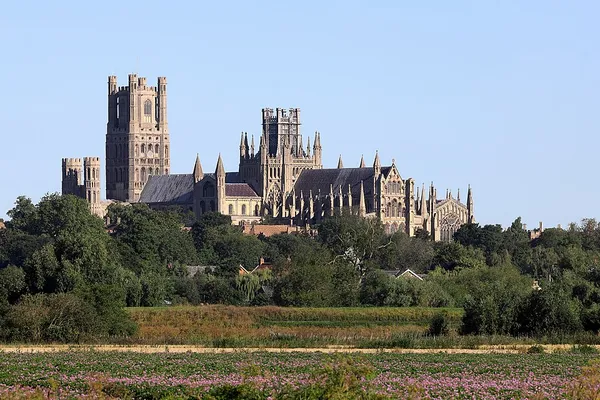
Ely Cathedral, formally the Cathedral Church of the Holy and Undivided Trinity of Ely, is an Anglican cathedral in the city of Ely, Cambridgeshire, England. The cathedral can trace its origin to the abbey founded in Ely in 672 by St Æthelthryth (also called Etheldreda). The earliest parts of the present building date to 1083, and it was granted cathedral status in 1109. Until the Reformation, the cathedral was dedicated to St Etheldreda and St Peter, at which point it was refounded as the Cathedral Church of the Holy and Undivided Trinity of Ely. It is the cathedral of the Diocese of Ely, which covers most of Cambridgeshire and western Norfolk, and Huntingdonshire. It is the seat of the Bishop of Ely and a suffragan bishop, the Bishop of Huntingdon. Architecturally, Ely Cathedral is outstanding both for its scale and stylistic details. Having been built in a monumental Romanesque style, the galilee porch, lady chapel and choir were rebuilt in an exuberant Decorated Gothic. Its most notable feature is the central octagonal tower, with lantern above, which provides a unique internal space and, along with the West Tower, dominates the surrounding landscape. The cathedral is a major tourist destination, receiving around 250,000 visitors per year, and sustains a daily pattern of morning and evening services.
Also on this shelf
Architecture of the Philippines.
Bishop's Palace, Lichfield.
See also
Uncatalogued shelfText from Wikipedia; plate via Wikimedia Commons. Text CC BY-SA 4.0; plate freely licensed (see Commons). Source record. Images and catalogue data are reproduced from open-access collections.