Architecture
Florence Baptistery
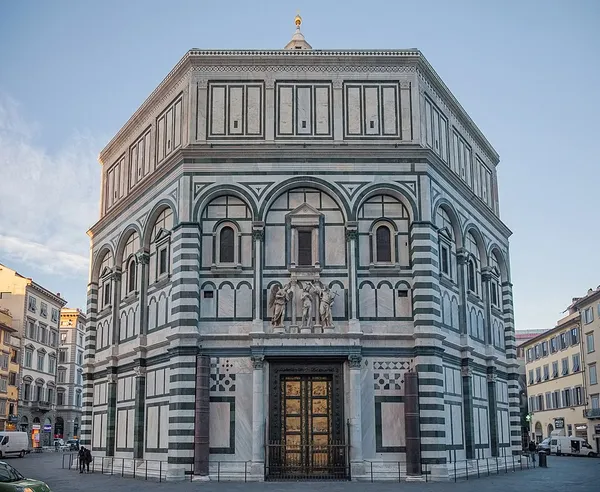
The Florence Baptistery, also known as the Baptistery of Saint John (Italian: Battistero di San Giovanni), is a religious building in Florence, Italy. Dedicated to the patron saint of the city, John the Baptist, it has been a focus of religious, civic, and artistic life since its completion. The octagonal baptistery stands in both the Piazza del Duomo and the Piazza San Giovanni, between Florence Cathedral and the Archbishop's Palace. Florentine infants were originally baptized in large groups on Holy Saturday and Pentecost in a five-basin baptismal font located at the center of the building. Over the course of the 13th century, individual baptisms soon after birth became common, so less apparatus was necessary. Around 1370 a small font was commissioned, which is still in use today. The original font, disused, was dismantled in 1577 by Francesco I de' Medici to make room for grand-ducal celebrations, an act deplored by Florentines at the time. The Baptistery serves as a focus for the city's most important religious celebrations, including the Festival of Saint John held on June 24, still a legal holiday in Florence. In the past the Baptistery housed the insignia of Florence and the towns it conquered and offered a venue to honor individual achievement like victory in festival horse races. Dante Alighieri was baptized there and hoped, in vain, that he would "return as poet and put on, at my baptismal font, the laurel crown." The city walls begun in 1285 may have been designed so that the baptistery would be at the exact center of Florence, like the temple at the center of the New Jerusalem prophesied by Ezekiel. The architecture of the Baptistery takes inspiration from the Pantheon, an ancient Roman temple, as observers have noted for at least 700 years, and yet it is also a highly original artistic achievement. The scholar Walter Paatz observed that the total effect of the Baptistery has no parallels at all. This singularity has made the origins of the Baptistery a centuries-long enigma, with hypotheses that it was originally a Roman temple, an early Christian church built by Roman master masons, or (the current scholarly consensus) a work of 11th- or 12th-century "proto-Renaissance" architecture.
Also on this shelf
Intentional community.
Argyle Building, Glasgow.
See also
Uncatalogued shelfText from Wikipedia; plate via Wikimedia Commons. Text CC BY-SA 4.0; plate freely licensed (see Commons). Source record. Images and catalogue data are reproduced from open-access collections.