Architecture
Franz Joseph I
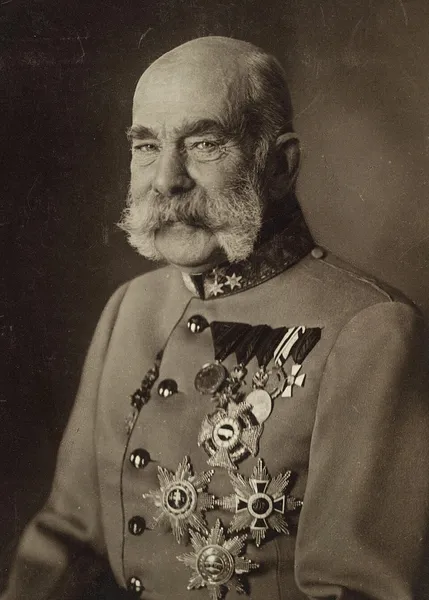
Franz Joseph I or Francis Joseph I (German: Franz Joseph Karl [fʁants ˈjoːzɛf ˈkaʁl]; Hungarian: Ferenc József Károly [ˈfɛrɛnt͡s ˈjoːʒɛf ˈkaːroj]; 18 August 1830 – 21 November 1916) was Emperor of Austria, King of Hungary, and the ruler of the other states of the Habsburg monarchy from 2 December 1848 until his death in 1916. In the early part of his reign, his realms and territories were referred to as the Austrian Empire, but in 1867 they were reconstituted as the dual monarchy of Austria-Hungary. From 1 May 1850 to 24 August 1866, he was also president of the German Confederation. In December 1848, Franz Joseph's uncle Emperor Ferdinand I abdicated the throne at Olomouc as part of Minister President Felix zu Schwarzenberg's plan to end the Hungarian Revolution of 1848. Franz Joseph then ascended to the throne at the age of eighteen. In 1854, he married his first cousin Duchess Elisabeth in Bavaria, with whom he had four children: Sophie, Gisela, Rudolf, and Marie Valerie. Largely considered a reactionary, Franz Joseph spent his early reign resisting constitutionalism in his domains. The Austrian Empire was forced to cede its influence over Tuscany and most of its claim to Lombardy–Venetia to the Kingdom of Sardinia, following the Second Italian War of Independence in 1859 and the Third Italian War of Independence in 1866. Although Franz Joseph ceded no territory to the Kingdom of Prussia after the Austrian defeat in the Austro-Prussian War, the Peace of Prague (23 August 1866) settled the German Question in favour of Prussia, which prevented the unification of Germany from occurring under the House of Habsburg. Franz Joseph was troubled by nationalism throughout his reign. He concluded the Austro-Hungarian Compromise of 1867, which both granted greater autonomy to Hungary and created the dual monarchy of Austria-Hungary. He ruled peacefully for the next 45 years, but suffered multiple personal tragedies: the execution of his brother Emperor Maximilian I of Mexico in 1867, the death by suicide of his son Rudolf in 1889, and the assassinations of first his wife Elisabeth in 1898 and then his nephew and heir presumptive, Archduke Franz Ferdinand, in 1914. After the Austro-Prussian War, Austria-Hungary turned its attention to the Balkans, then a hotspot of international tension due to Austria's interests conflicting with both the Ottoman and Russian Empires.
Also on this shelf
Cathedral of St. Alban the Martyr.
Embrun Cathedral.
See also
Uncatalogued shelfText from Wikipedia; plate via Wikimedia Commons. Text CC BY-SA 4.0; plate freely licensed (see Commons). Source record. Images and catalogue data are reproduced from open-access collections.