Architecture
Bydgoszcz Architects (1850–1970s)
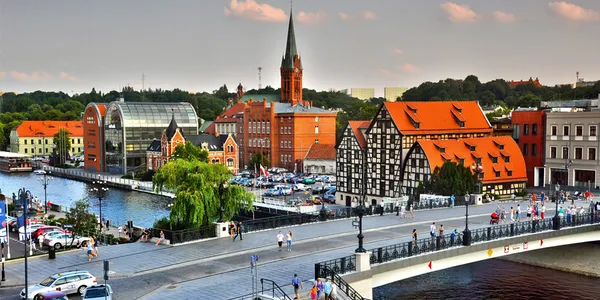
Bydgoszcz displays an abundant variety of architectures, with styles from neo-gothic, neo-baroque and neoclassicism, to Art Nouveau and modernism; hence its nickname of Little Berlin at the start of the 20th century. The notable granaries on Mill Island and along Brda river also recall a recognized timber-framed characteristics of the city in Poland. The period stretching from 1850 to the Second Polish Republic witnessed the greatest development of the city. In the mid-19th century, the arrival of the Prussian Eastern Railway (German: Preußische Ostbahn) contributed greatly to the development of Bromberg. After WWI, with the re-attachment of the town to the new state of Poland, Bydgoszcz underwent anew a growth, while German residents fled. Most of the constructions of these time, still preserved today, are linked to a number of architects who left (for a few of them) a profound mark on the current architectural landscape of the city.
Also on this shelf
18th-century Western domes.
Constructivist architecture.
See also
- ▸Cathedral Basilica of Our Lady of Assumption, Mariana
- ▸Alternanthera echinocephala
- ▸Ippolito II d'Este
Text from Wikipedia; plate via Wikimedia Commons. Text CC BY-SA 4.0; plate freely licensed (see Commons). Source record. Images and catalogue data are reproduced from open-access collections.