Architecture
Decorated Gothic
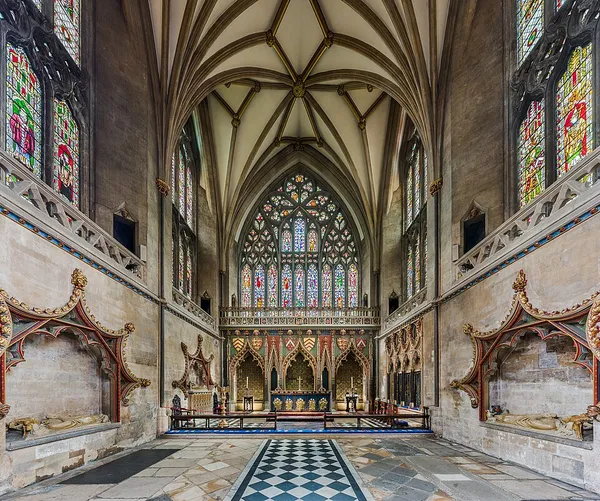
Decorated Gothic (also Second Pointed, often abbreviated to Dec) was the second phase of English Gothic architecture, in vogue from the mid-13th to mid-14th centuries. It was distinguished by a unification of all arts to form one elaborate whole, with traceried windows, ornate surface decoration, complex geometry and intricate vaulting. The style saw the introduction of new architectural forms: especially the traceried window, but also the ogee arch, the lierne vault and 'bubbly' foliage carving. It is notable for using forms ornamentally rather than structurally. Decorated Gothic can be divided into two phases: Geometrical Decorated (pre-c.1290) and Curvilinear (or Flowing) Decorated (post-c.1290). While the Decorated was primarily an architectural style for churches, it also covered secular buildings, furnishings, sculpture and elements of applied arts like metalwork and manuscript illumination.
Also on this shelf
Bayombong Cathedral.
Church of the Light.
See also
Uncatalogued shelfText from Wikipedia; plate via Wikimedia Commons. Text CC BY-SA 4.0; plate freely licensed (see Commons). Source record. Images and catalogue data are reproduced from open-access collections.