Architecture
Architecture of Chiswick House
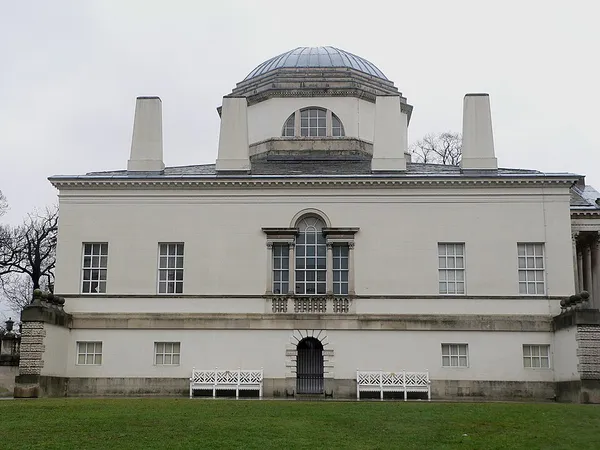
Chiswick House is an example of English Palladian Architecture in Burlington Lane, Chiswick, in the London Borough of Hounslow in England. Arguably the finest remaining example of Neo-Palladian architecture in London, the house was designed by Lord Burlington, and built between 1727 and 1729. The architectural historian Richard Hewlings has established that Chiswick House was an attempt by Lord Burlington to create a Roman villa, rather than Renaissance pastiche, situated in a symbolic Roman garden. Chiswick House is inspired in part by several buildings of the 16th-century Italian architects Andrea Palladio (1508–1580) and his assistant Vincenzo Scamozzi (1552–1616). The house is often said to be directly inspired by Palladio's Villa Capra "La Rotonda" near Vicenza, due to the fact that architect Colen Campbell had offered Lord Burlington a design for a villa very closely based on the Villa Capra for his use at Chiswick. However, although still clearly influential, Lord Burlington had rejected this design and it was subsequently used at Mereworth Castle, Kent. The brick-built Villa's facade is faced in Portland stone, with a small amount of stucco. The finely carved Corinthian capitals on the projecting six-column portico at Chiswick, carved by John Boson, are derived from Rome's Temple of Castor and Pollux. The inset door, projecting plinth and 'v'-necked rusticated vermiculation (resembling tufa) were all derived from the base of Trajan's Column. The short sections of crenellated wall with ball finials which extend out either side of the villa were symbolic of medieval (or Roman) fortified town walls and were inspired by their use by Palladio at his church of San Giorgio Maggiore in Venice and by Inigo Jones (1573–1652) (Palladio also produced woodcuts of the Villa Foscari with crenellated sections of walls in his I quattro libri dell'architettura in 1570, yet in reality they were never built). To reinforce this link two full-length statues of Palladio and Jones by the celebrated Flemish-born sculptor John Michael Rysbrack (1694–1770) are positioned in front of these sections of wall. Palladio's influence can also be found in the general cubic form of the villa with its central hall with other rooms leading off its axis. The villa is a half cube with a side of 70 feet (21 m), 35 feet high.
Also on this shelf
Italian art.
Compton Mackenzie.
See also
Uncatalogued shelfText from Wikipedia; plate via Wikimedia Commons. Text CC BY-SA 4.0; plate freely licensed (see Commons). Source record. Images and catalogue data are reproduced from open-access collections.