Ancient World
Aineta aryballos
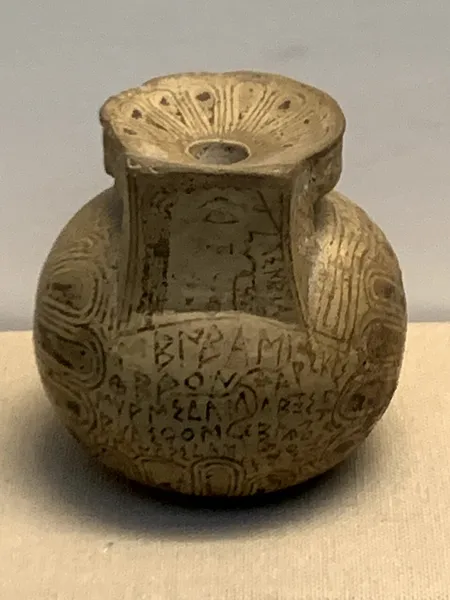
The Aineta aryballos is an ancient Greek aryballos (a small, spherical flask or vase), made between approximately 625 and 570 BCE in the city of Corinth in southern Greece. Approximately 6.35 centimetres (2.50 in) in both height and diameter, it was intended to contain perfumed oil or unguent, and is likely to have been owned by a high-class courtesan (hetaira) by the name of Aineta, who may be portrayed in a drawing on its handle. The vase's illegal sale to the British Museum in 1865 led to the prosecution of its seller, the Athenian professor and art dealer Athanasios Rhousopoulos, and exposed his widespread involvement in antiquities crime. The vase is inscribed with a portrait, generally agreed to be that of a woman and probably that of Aineta, who is named in the inscription on the vase. Below the portrait are the names of nine men, usually taken to be Aineta's admirers or lovers. The Aineta aryballos is likely to have been found in a grave, probably that of Aineta. According to Rhousopoulos, it was discovered in Corinth around 1852. In 1877, Panagiotis Efstratiadis, the Ephor General of Antiquities in charge of the Greek Archaeological Service, had Rhousopoulos fined for selling the vase in contravention of Greek law. Writing in 2012 for the Center for Hellenic Studies, Yannis Galanakis called the case "a milestone in the trafficking of Greek antiquities", in that it represented a relatively rare successful use of state power against the illegal trade in ancient Greek artefacts.
Also on this shelf
Cilurnum.
Dhahran Burial Mounds.
See also
Uncatalogued shelfText from Wikipedia; plate via Wikimedia Commons. Text CC BY-SA 4.0; plate freely licensed (see Commons). Source record. Images and catalogue data are reproduced from open-access collections.