Ancient World
Dome of the Rock
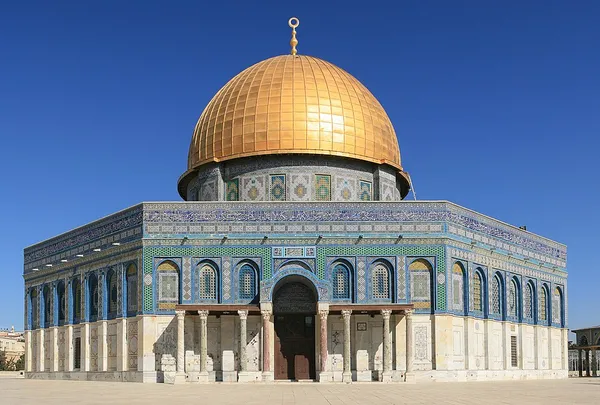
The Dome of the Rock (Arabic: قبة الصخرة, romanized: Qubbat aṣ-Ṣaḫra) is an octagonal Islamic shrine at the center of the Al-Aqsa mosque compound on the Temple Mount in the Old City of Jerusalem. It is the world's oldest surviving work of Islamic architecture, the earliest archaeologically-attested religious structure to be built by a Muslim ruler and contains the earliest inscriptions proclaiming Islam and the prophet Muhammad. Its initial construction was undertaken by the Umayyad Caliphate on the orders of Abd al-Malik during the Second Fitna in 691–692 CE, and it has been built on top of the Foundation Stone (or Noble Rock). The site's significance for Muslims derives from the belief that the Night Journey of Muhammad began from the rock at the centre of the structure. It is believed in Christianity and Judaism to be the site where Abraham attempted to sacrifice his son, and it is believed to be built on the site of the Second Jewish Temple (built in c. 516 BCE to replace the destroyed Solomon's Temple and expanded by Herod the Great), which was destroyed by the Romans in 70 CE. The temple bears great significance in Judaism as the place where God created the world as well as the first human, Adam, and as the place where God's divine presence is manifested more than in any other place, towards which Jews turn during prayer. Its plan and original mosaic decoration were patterned after nearby Byzantine churches and palaces. The octagonal plan may have been influenced by the Byzantine-era Church of the Seat of Mary (also known as Kathisma in Greek and al-Qadismu in Arabic), which was built between 451 and 458 on the road between Jerusalem and Bethlehem. The large dome has a subtly bulbous form. The original dome collapsed in 1015 and was rebuilt in 1022–23. The monument's outside appearance was significantly changed during the early Ottoman period, when brightly coloured, mainly blue-and-white Iznik-style tiles were applied to the exterior, and again in the modern period, notably with the addition of the gold-plated roof, in 1959–64 and again in the 1990s. Designated by UNESCO as a World Heritage Site, it has been called "Jerusalem's most recognizable landmark" Its golden dome dominates Jerusalem’s skyline, and remains visible from all approaches to the city.
Also on this shelf
Child sacrifice.
Archaeological remnants of the Jerusalem Temple.
See also
Uncatalogued shelfText from Wikipedia; plate via Wikimedia Commons. Text CC BY-SA 4.0; plate freely licensed (see Commons). Source record. Images and catalogue data are reproduced from open-access collections.