Ancient World
Ancient Carthage
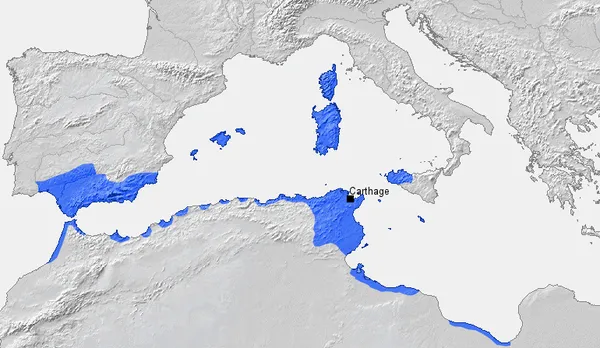
Ancient Carthage ( KAR-thij; Punic: 𐤒𐤓𐤕𐤟𐤇𐤃𐤔𐤕, lit. 'New City') was an ancient civilization based in North Africa. It grew from a small settlement in present-day Tunisia into the Carthaginian Empire, a major power that dominated the western half of the Mediterranean Sea. Carthage was settled around 814 BC by merchants from Tyre, a leading Phoenician city-state located in present-day Lebanon. In the 7th century BC, following Phoenicia's conquest by the Neo-Assyrian Empire, Carthage became independent of its eastern neighbors. Leveraging its naval power, Carthage then began to grow a vast patchwork of colonies, vassals, and satellite states until it was the economic and political hegemon of the western Mediterranean. By 300 BC, Carthage controlled the coast of northwestern Africa, southern and eastern Iberia, and the islands of Sicily, Sardinia, Corsica, Malta, and the Balearic Islands. Tripoli remained de facto autonomous under the authority of local Libyco-Phoenicians, a mixed Nation of local Libyans (specifically Macae) and Phoenicians, who paid nominal tribute. Among the ancient world's largest and richest cities, Carthage's strategic location provided access to abundant fertile land and major maritime trade routes that reached West Asia and Northern Europe. This commercial empire was secured by one of the largest and most powerful navies in classical antiquity, and an army composed heavily of foreign mercenaries and auxiliaries, which included Iberians, Balearics, Gauls, Britons, Sicilians, Italians, Greeks, Numidians, and Libyans. Carthage's unique system of government combined at different times elements of primitive democracy, oligarchy, and republicanism, including early examples of separation of powers. As the dominant power in the western Mediterranean, Carthage inevitably came into conflict with many neighbours and rivals, from the Berbers of North Africa to the nascent Roman Republic. Following centuries of conflict with the Sicilian Greeks, its growing competition with Rome culminated in the Punic Wars (264–146 BC), which saw some of the largest and most sophisticated battles in antiquity. Carthage narrowly avoided destruction after the Second Punic War, but was destroyed by the Romans in 146 BC after the Third Punic War. The Romans later founded a new city in its place.
Also on this shelf
Gallo-Roman temple of Izernore.
Dan Warner.
See also
Uncatalogued shelfText from Wikipedia; plate via Wikimedia Commons. Text CC BY-SA 4.0; plate freely licensed (see Commons). Source record. Images and catalogue data are reproduced from open-access collections.