Ancient World
Cro-Magnon
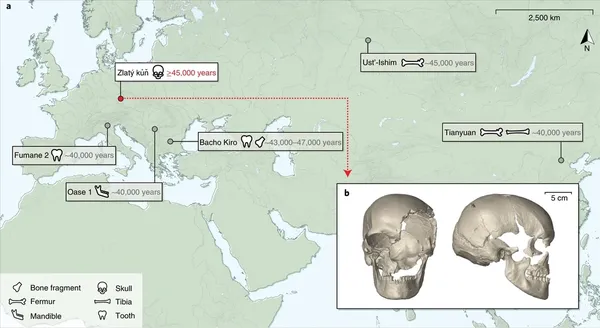
Cro-Magnons or European early modern humans (EEMH) were the first surviving expansion of early modern humans (Homo sapiens) found in Europe and Siberia, continuously occupying the continent possibly from as early as 56,800 years ago. They interacted and interbred with the indigenous Neanderthals (H. neanderthalensis) of Europe and Western Asia, who went extinct 35,000 to 40,000 years ago. At the time of this admixture, those Neanderthals already possessed about 6% Homo sapiens ancestry, from admixture with an earlier, extinct sapiens population in Eurasia earlier than 240kya. Ancient DNA research indicates that the earliest modern humans in Europe during the Initial Upper Paleolithic (~45–40 kya) were part of the broader early expansion of Homo sapiens from Eurasia. Genetic data show that some early European individuals, such as those associated with the Lincombian-Ranisian-Jerzmanowician technocomplex, represent lineages that left little or no detectable ancestry in later European populations. However, other lineages present in Europe by ~38–37 kya are genetically closer to later Upper Paleolithic Europeans. These surviving Upper Paleolithic populations contributed ancestry to Mesolithic European hunter-gatherers, including Western Hunter-Gatherers (WHG), who in turn form one of the principal ancestral components of present-day Europeans. Rather than reflecting a separate later migration into Europe prior to the Neolithic, current evidence supports a model of early population structure followed by lineage extinction and survival within the initial Homo sapiens expansion from the continent. Cro-Magnons produced Upper Palaeolithic cultures, the first major one being the Aurignacian, which was succeeded by the Gravettian by 30,000 years ago. The Gravettian split into the Epi-Gravettian in the east and Solutrean in the west, due to major climatic degradation during the Last Glacial Maximum (LGM), peaking 21,000 years ago. As Europe warmed, the Solutrean evolved into the Magdalenian by 20,000 years ago, and these peoples recolonised Europe. The Magdalenian and Epi-Gravettian gave way to Mesolithic cultures as big game animals were dying out, and the Last Glacial Period drew to a close.
Also on this shelf
Arachne (archaeological database).
Greek Dark Ages.
See also
Uncatalogued shelfText from Wikipedia; plate via Wikimedia Commons. Text CC BY-SA 4.0; plate freely licensed (see Commons). Source record. Images and catalogue data are reproduced from open-access collections.