Ancient World
Hephthalite–Sasanian Wars
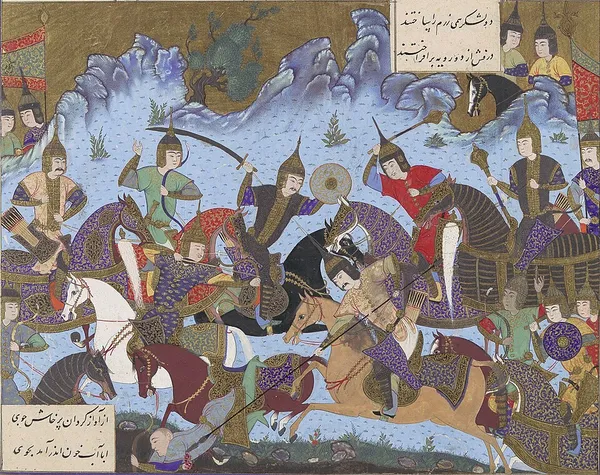
The Hephthalite–Sasanian Wars were a series of conflicts between the White Huns and the Persian Empire. The most significant of these occurred in 484 with the death of Shah Peroz I at the hands of the Hephthalites. The Sasanian empire, while being one of the strongest continental powers in its region, suffered from a relative weakness of its eastern frontier, which was bordered by steppes where various pastoral nomadic peoples lived. The Hunnic dynasty of Hephthalites was one of such nomadic empires formed in the 5th century in the steppes of the eastern borderlands of Persia. The Sassanid Shahs fought a series of wars against Hephthalites, most notably Bahram V and Peroz I. However, these efforts led to a catastrophic defeat of Persians in 484 when Peroz I was killed during one of his invasions, resulting in Persians paying a large tribute to the Hephthalites and the Sasanian empire effectively becoming the Hephthalite satellite for next 50 years. Shah Kavad I was only able to ascend to the Persian throne with the Hephthalite support. Only under Khosrow I was the Persian empire eventually able to liberate itself from the Hephthalite influence, as the emerging Turkic peoples in the 550s threatened the Hephthalite interests from the east, which eventually led to the joint attack on Hephthalites by Persians and Turks in 563 (or 557). However, for Persia, the defeat of Hephthalites only substituted one nomadic neighbor with another, and arguably much more powerful one.
Also on this shelf
Bilsk hillfort.
Ethiopia in the Middle Ages.
See also
Uncatalogued shelfText from Wikipedia; plate via Wikimedia Commons. Text CC BY-SA 4.0; plate freely licensed (see Commons). Source record. Images and catalogue data are reproduced from open-access collections.