Ancient World
Frisian Kingdom
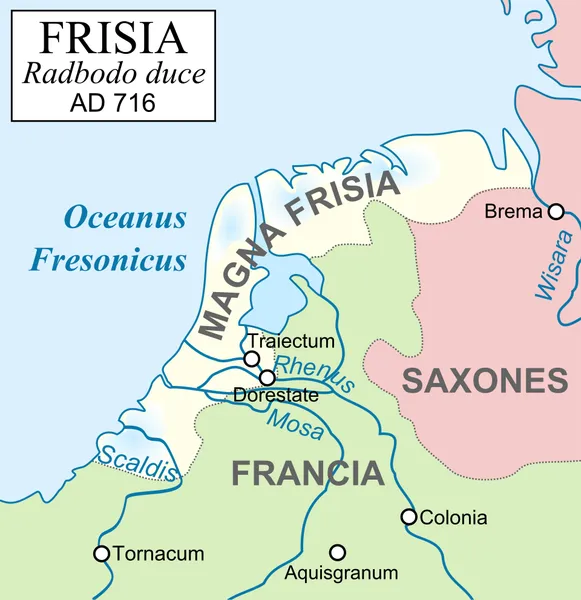
The Frisian Kingdom (; West Frisian: Fryske Keninkryk) is a modern name for the post-Roman Frisian realm in Western Europe in the period when it was at its largest (650–734). This dominion was ruled by kings and emerged in the mid-7th century and probably ended with the Battle of the Boarn in 734 when the Frisians were defeated by the Frankish Empire. It lay mainly in what is now the Netherlands and – according to some 19th century authors – extended from the Zwin near Bruges in Belgium to the Weser in Germany. The center of power was the city of Utrecht. In medieval writings, the region is designated by the Latin term Frisia. There is a dispute among historians about the extent of this realm; There is no documentary evidence for the existence of a permanent central authority. Possibly, Frisia consisted of multiple petty kingdoms, which transformed in time of war to a unit to resist invading powers, and then headed by an elected leader, the primus inter pares. It is possible that Redbad established an administrative unit. Among the Frisians at that time, there was no feudal system.
Also on this shelf
Holy of Holies.
KV47.
See also
Uncatalogued shelfText from Wikipedia; plate via Wikimedia Commons. Text CC BY-SA 4.0; plate freely licensed (see Commons). Source record. Images and catalogue data are reproduced from open-access collections.