Ancient World
Adadnadinakhe bricks
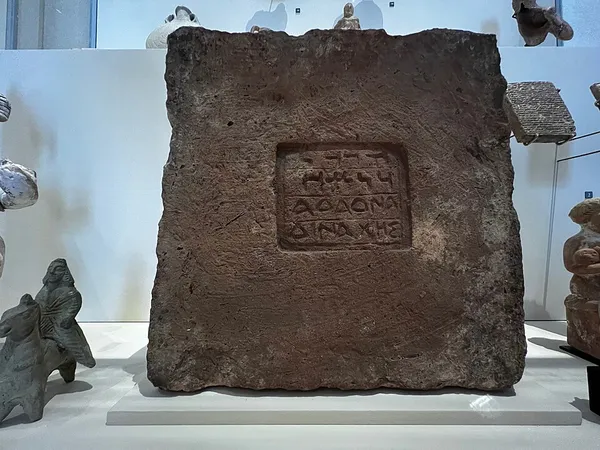
The Adadnadinakhe bricks are a series of foundation bricks with mudbrick stamps discovered at the Sumerian city of Girsu bearing the name "Adadnadinakhe" in bilingual Greek and Aramaic inscriptions. The bricks date back to the Seleucid Empire – 300–100 BCE – whilst the name appears to match the name of a Babylonian king (Ashur-nadin-ahhe I or Ashur-nadin-ahhe II) who ruled more than a millennium beforehand. They form part of a larger group of Canaanite and Aramaic seal inscriptions. The first known brick was discovered in the 1880s, and the most recent in the 2020s. The Aramaic inscription is known as NE 446c and CIS II 72. Early examples of the brick are displayed in the Louvre and in the Vorderasiatisches Museum Berlin. In the Louvre, 21 examples from Girsu are known, in the series AO 29762–29782, of which AO 29762 is in room 230, AO 29775 is in room 310, and AO 29763 has been loaned to the Musée d'archéologie méditerranéenne in Marseille.
Also on this shelf
Jean-Louis Brunaux.
Beit Alfa.
See also
Uncatalogued shelfText from Wikipedia; plate via Wikimedia Commons. Text CC BY-SA 4.0; plate freely licensed (see Commons). Source record. Images and catalogue data are reproduced from open-access collections.