Ancient World
Beveled rim bowl
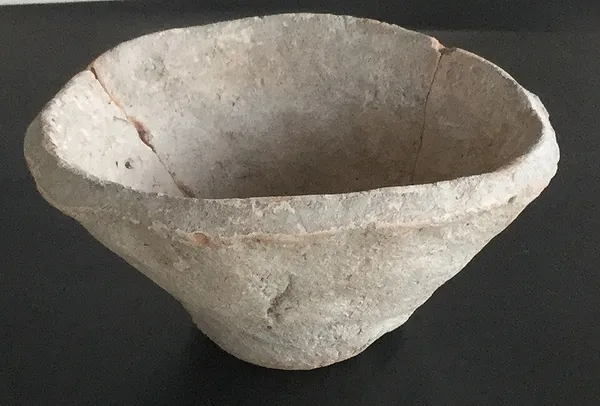
Beveled rim bowls (traditionally called Glockentöpfe) are small, undecorated, mass-produced clay bowls most common in the 4th millennium BC during the Late Chalcolithic period. They constitute roughly three quarters of all ceramics found in Uruk culture sites, are therefore a unique and reliable indicator of the presence of the Uruk culture in ancient Mesopotamia. Beveled rim bowls began to appear in the Early Uruk period (c. 3900-3600 BC) in Southern Mesopotamia with a few exemplars being found in Northern Mesopotamian sites like Tell Brak. They replaced the "wide flowerpots" (flat based, shallow, open bowls with a flared or conical profile) then common. They were common in the Middle Uruk period (c. 3600-3400 BC) throughout Mesopotamia and in some sites in Iran. In the Late Uruk period (c. 3400-3200 BC). In the subsequent Late Uruk and Jemdat Nasr periods (c. 3400-3100 BC) their use declined in Southern Mesopotamia and Iran along with a rise in numbers of the ceramics called "tall flowerpots" (Grosse Blumentopfe), which were of similar fabric as Beveled Rim Bowls but were wheel made, whose use is also still unclear. BRBs continued in use in Northern Mesopotamia in that period. Beveled rim bowls remained in use in a few sites in Syro-Anatolia during the Early Dynastic I period (c. 3100-2900 BC). Early on it was suggested that one of the signs of Proto-cuneiform, and perhaps a corresponding sign in Cuneiform (GAR/NINDA/AKALU), was derived from the bevelled rim bowl.
Also on this shelf
Christian Maclagan.
Hephthalite–Sasanian Wars.
See also
Uncatalogued shelfText from Wikipedia; plate via Wikimedia Commons. Text CC BY-SA 4.0; plate freely licensed (see Commons). Source record. Images and catalogue data are reproduced from open-access collections.