Ancient World
Baalbek Stones
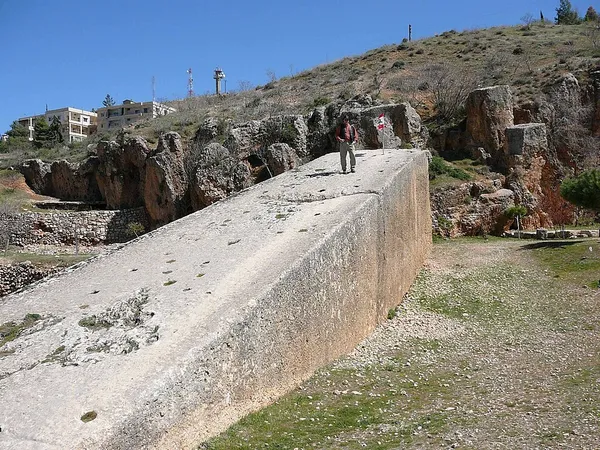
The Baalbek Stones are six massive Roman worked stone blocks in Baalbek (ancient Heliopolis), Lebanon, characterised by a megalithic gigantism unparalleled in antiquity. The stone was quarried from nearby hillsides, and several of the large monoliths - some only partially hewn from the geology. The smaller three are part of a podium wall in the Roman complex of the Temple of Jupiter Baal (Heliopolitan Zeus) known as the "Trilithon". Each of these is estimated at 750–800 tonnes (830–880 short tons). The quarry was slightly higher than the temple complex, so no lifting was required to move the stones. The large stones may have been moved into position on rollers along temporary earthen banks from the quarry. The remaining three are Roman monoliths, not part of a larger structure, conventionally known as the "Stone of the Pregnant Woman" (estimated at 1,000 t), the "Stone of the South" (est. 1,242 t), and the "Forgotten Stone" (est. 1,650 t). These are the first, third, and tied fifth largest known stones ever quarried in human history. They are believed to have been intended for the nearby Jupiter Baal complex, possibly as an addition to the Trilithon; but, they were never removed from their quarry. They have not been used since their extraction - some only partially extracted - in ancient times. Numerous archaeological expeditions have gone to the site starting in the 19th century, primarily German and French groups, and research has continued into the 21st century.
Also on this shelf
Islamic architecture.
Brygos.
See also
Uncatalogued shelfText from Wikipedia; plate via Wikimedia Commons. Text CC BY-SA 4.0; plate freely licensed (see Commons). Source record. Images and catalogue data are reproduced from open-access collections.