Ancient World
Ashkenazi Jews
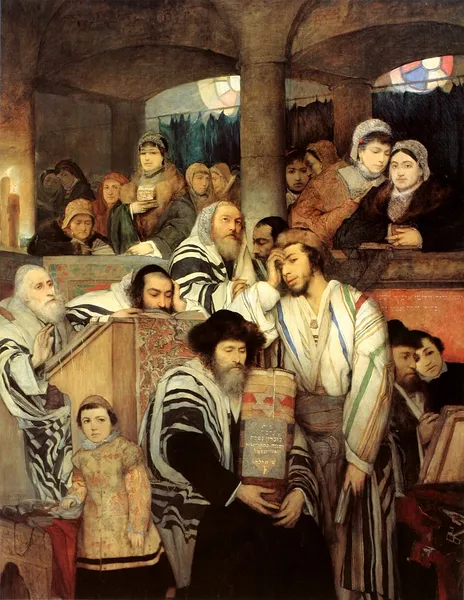
Ashkenazi Jews, also known as Ashkenazic Jews, Ashkenazis, or Ashkenazim, are a distinct ethnic subdivision of the Jewish diaspora. The Ashkenazim emerged from the Jewish communities that consolidated during the 10th century in the Rhineland (western Germany) and in northern France, having migrated there from centers such as the Italian Peninsula and the Southern Levant. After numerous massacres of Jews during the Crusades (11th–13th centuries), they began a gradual eastward migration due to mounting restrictions within the Holy Roman Empire and the favorable policies of Casimir III the Great of Poland and others. This migration ramped up after the persecution of Jews during the Black Death during the 14th century, such that by the 16th century, the bulk of the Ashkenazi Jews had migrated to the Kingdom of Poland, which includes modern Poland, Lithuania, Belarus, Ukraine, and parts of Russia. This area became the main center of Ashkenazi Jewry until the Holocaust. Ashkenazim adapted their traditions, rites and customs to Europe. They traditionally follow the German rite synagogue ritual and until the Holocaust primarily spoke Yiddish, an offshoot of Middle High German written in a variety of the Hebrew script, with significant Hebrew, Aramaic, and Slavic influence. From the late 18th century onwards, Ashkenazi communities underwent significant religious and cultural transformations, under the influence of the Haskalah (Jewish Enlightenment) and the struggle for Jewish emancipation in European states that restricted their rights. Among other things, Maskilim (adherents of the Haskalah) advocated the adoption of national languages instead of Yiddish, as well as increased study and usage of the Hebrew language, in order to modernize Jewish religious practice and identity. The Hebrew language, whose usage until then had been primarily liturgical and clerical, was progressively revived as a common language starting from the 19th century, fueled by these aspirations of both religious and national revival. The Yiddish language progressively declined in prestige, in favor of national languages and Hebrew, being stigmatized by both assimilationists and Zionists, though it remained spoken by over 11 million people worldwide prior to the Holocaust.
Also on this shelf
Bunnik Hoard.
Göbekli Tepe.
See also
Uncatalogued shelfText from Wikipedia; plate via Wikimedia Commons. Text CC BY-SA 4.0; plate freely licensed (see Commons). Source record. Images and catalogue data are reproduced from open-access collections.