Ancient World
Carthage tophet
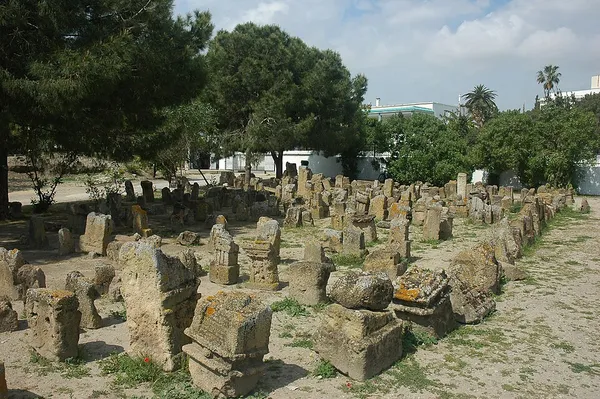
The Carthage tophet is an ancient sacred area dedicated to the Phoenician deities Tanit and Baal Hammon, located in the Carthaginian district of Salammbô, Tunisia, near the Punic ports. This tophet, a "hybrid of sanctuary and necropolis", contains a large number of children's tombs, estimated to be over 20,000, which, according to some interpretations, were sacrificed or buried here after their untimely death. The area is part of the Carthage archaeological site, a UNESCO World Heritage Site. The question of the fate of these children is closely linked to Phoenician and Punic religion, but above all to the way in which religious rites – and beyond that, Phoenician and Punic civilization – were perceived by the Jews in the case of the Phoenicians, or by the Romans during the conflicts that pitted them against the Punics. Indeed, the term "tophet" was originally used to designate a place near Jerusalem, synonymous with hell: this name, taken from biblical sources, leads to a macabre interpretation of the rites supposed to take place there. Recent works have been inspired on this site's history, such as Gustave Flaubert's novel Salammbô (1862), which gave its name to the district where the sanctuary was discovered. Also, the comic strip Le Spectre de Carthage, part of the adventures of Alix written by Jacques Martin, gets inspiration from here. The major difficulty in determining the cause of the burials lies in the fact that the only written sources reporting the rite of child sacrifice are all foreign to the city of Carthage (for example, Bible). As for the archaeological sources – stelae and cippes – they are open to multiple interpretations. As a result, the debate between the various historians who have studied the subject has been lively for a long time, and has yet to be completely settled. The utmost caution is therefore called for, as ancient historians are faced with written and archaeological sources that are, if not divergent, at least open to interpretation.
Also on this shelf
Eritrea.
Ancient Egyptian architecture.
See also
Uncatalogued shelfText from Wikipedia; plate via Wikimedia Commons. Text CC BY-SA 4.0; plate freely licensed (see Commons). Source record. Images and catalogue data are reproduced from open-access collections.