Ancient World
Falasarna
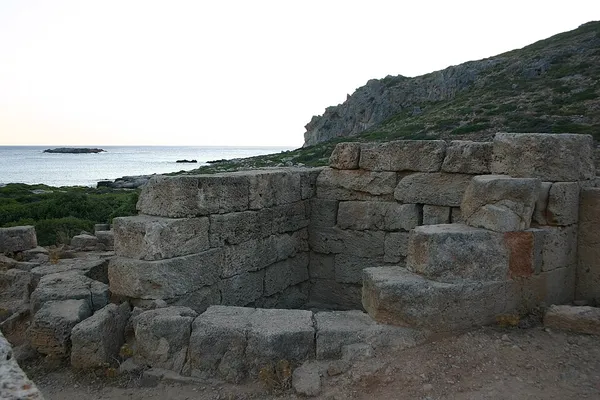
Falasarna or Phalasarna (Ancient Greek: Φαλάσαρνα) is a Greek harbour town at the west end of Crete that flourished during the Hellenistic period. The currently visible remains of the city include several imposing sandstone towers and bastions, with hundreds of metres of fortification walls protecting the town, and a closed harbour, meaning it is protected on all sides by city walls. The harbour is ringed by stone quays with mooring stones, and connected to the sea through two artificial channels. Notable finds in the harbour area include public roads, wells, warehouses, an altar, and baths. Most of these structures were revealed by excavations that began in 1986. The acropolis is built on a cape that rises 90 metres above the harbour and juts into the sea. The acropolis has many remains, including a temple dedicated to goddess Dictynna, fortification towers, cisterns, wells, and watchtowers that could have been used to guard sea routes. Today Falasarna is an agricultural area and tourist attraction. The valley is filled with olive groves and greenhouses cultivating mainly tomatoes; there are also scattered family-run hotels and restaurants. The seaside has long sandy beaches and crystal-clear waters that are popular both with residents of the province of Chania and visitors from Greece and abroad. Falasarna beach was voted, in a CNN poll, among the best 100 beaches of the world.
Also on this shelf
Bidar.
Colonia Ulpia Traiana.
See also
Uncatalogued shelfText from Wikipedia; plate via Wikimedia Commons. Text CC BY-SA 4.0; plate freely licensed (see Commons). Source record. Images and catalogue data are reproduced from open-access collections.