Ancient World
Ayn Ghazal statues
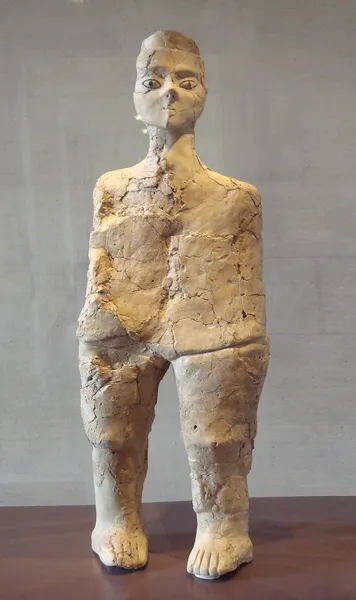
The ʿAin Ghazal statues are large-scale lime plaster and reed statues discovered at the archaeological site of ʿAin Ghazal in Amman, Jordan, dating back to approximately 9,000 years ago (made between 7200 BC and 6250 BCE), from the Pre-Pottery Neolithic C period. A total of 15 statues and 15 busts were discovered in 1983 and 1985 in two underground caches, created about 200 years apart. The statues are among the earliest large-scale representations of the human form and represent remarkable specimens of prehistoric art from the Pre-Pottery Neolithic B or C period. Their purpose remains uncertain, with archaeologists believing they may have been buried just after production, having possibly been made with that intent. The ʿAin Ghazal Statues are today part of the collections of The Jordan Museum in Amman, with some also on display at the Amman Citadel's Jordan Archaeological Museum, while a few have been loaned to foreign museums: one statue is in the Louvre Museum in Paris; parts of two other statues can be seen at the British Museum in London; and one of the figures with two heads is on show in the Louvre Abu Dhabi.
Also on this shelf
Al-Yahudu Tablets.
History of Indigenous Australians.
See also
Uncatalogued shelfText from Wikipedia; plate via Wikimedia Commons. Text CC BY-SA 4.0; plate freely licensed (see Commons). Source record. Images and catalogue data are reproduced from open-access collections.