Ancient World
Babylon
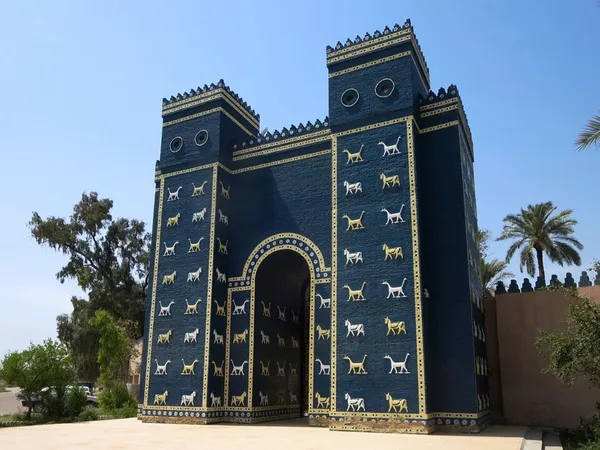
Babylon ( BAB-il-on) was an ancient city located on the lower Euphrates river in southern Mesopotamia, within modern-day Hillah, Iraq, about 85 kilometres (53 miles) south of modern-day Baghdad. Babylon functioned as the main cultural and political centre of the Akkadian-speaking region of Babylonia. Its rulers established two important empires in antiquity, the 19th–16th century BC Old Babylonian Empire, and the 7th–6th century BC Neo-Babylonian Empire. Babylon also served as a regional capital of other empires, such as the Achaemenid Empire. Babylon was one of the most important urban centres of the ancient Near East until its decline during the Hellenistic period. Nearby ancient sites include Kish, Borsippa, Dilbat, and Kutha. Both the Hanging Gardens and Walls of Babylon were ranked among the Seven Wonders of the Ancient World. The gardens purportedly existed between approximately 600 BC and AD 1, but some scholars question their historical reality, as they are not mentioned in any extant Babylonian text. The earliest known mention of Babylon as a small town appears on a clay tablet from the reign of Shar-Kali-Sharri (2217–2193 BC), of the Akkadian Empire. Babylon was a religious and cultural centre at this point but was neither an independent state nor a large city, merely a town of the Akkadian Empire. The collapse of the Akkadian Empire was followed by a few decades under the south Mesopotamian Gutian Dynasty, then the Third Dynasty of Ur ruling the whole of Mesopotamia, including the town of Babylon. The town became part of a small independent city-state in the early second millennium BC. The Amorite king Hammurabi founded the Old Babylonian Empire in the 18th century BC. He built Babylon into a major city and declared himself its king. Southern Mesopotamia became known as Babylonia, and Babylon eclipsed Nippur as the region's holy city. The empire waned under Hammurabi's son Samsu-iluna, and Babylon spent long periods under Assyrian, Kassite and Elamite domination. After the Assyrians destroyed and then rebuilt it, Babylon became the capital of the short-lived Neo-Babylonian Empire, from 626 to 539 BC. After the fall of the Neo-Babylonian Empire, the city came under the rule of the Achaemenid, Seleucid, Parthian, Roman, Sassanid, and Muslim empires.
Also on this shelf
Economy of pre-Islamic Arabia.
Archaeological site of Carthage.
See also
Uncatalogued shelfText from Wikipedia; plate via Wikimedia Commons. Text CC BY-SA 4.0; plate freely licensed (see Commons). Source record. Images and catalogue data are reproduced from open-access collections.