Ancient World
Glass in sub-Saharan Africa
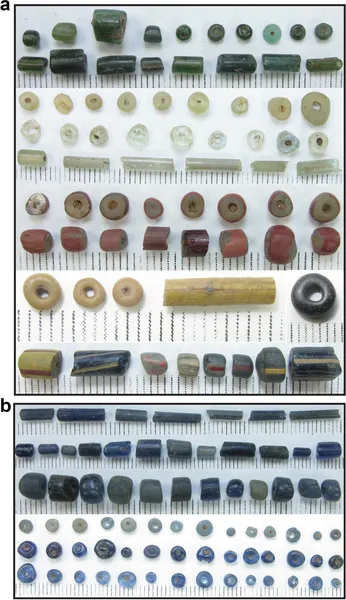
Glass in sub-Saharan Africa mostly consists of the importation of glass beads into sub-Saharan Africa, shipped primarily from the Middle East and India as early as 200-300 AD; later, from Portugal, the Netherlands, and Venice. Due to various differences in cultural histories and environmental resources, West African nations developed glass traditions distinct from Egypt, North Africa, and the rest of the world. As most African cultures have long histories of crafting and adornment with beads made from wood, bone and shell, the introduction of glass as a bead material was widely and rapidly received. The exchange of glass beads for local goods such as ivory, gold and slaves aided in the accumulation of wealth and creation of unequal power dynamics still apparent today. Archaeological evidence, primarily from various burial sites from the West and coastal port cities in the East, confirm the import of hundreds of thousands of glass beads. These assemblages boast rich varieties in shape, color, texture and patterning. While most glass in sub-Saharan Africa was imported as pre-formed beads, there is evidence of the importation of glass fragments and ingots to be used in local beadmaking practices. Preliminary excavations also exhibit evidence of indigenous glass production from raw materials, a technology previously thought unknown to this region of the world. Recent evidence has shown that glass making may have been started separate from the general glass trade as early as the 1500s.
Also on this shelf
Boundary End Archaeology Research Center.
Al-Okhdood.
See also
Uncatalogued shelfText from Wikipedia; plate via Wikimedia Commons. Text CC BY-SA 4.0; plate freely licensed (see Commons). Source record. Images and catalogue data are reproduced from open-access collections.