Ancient World
Feast of the Cross
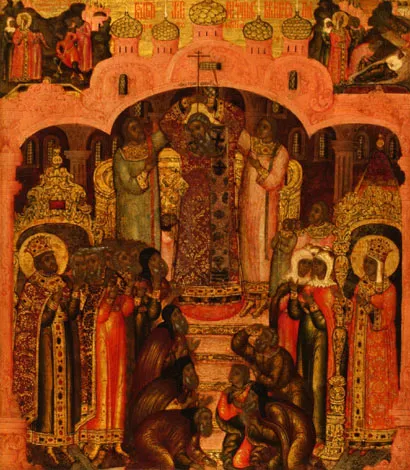
The Feast of the Holy Cross, Feast of the Exaltation of the Holy Cross, or Feast of the Cross commemorates the True Cross. On 13 September 335, the Constantinian Basilica over the Holy Sepulchre was consecrated in Jerusalem. The day after the church's consecration, the relic of the cross was shown ("exalted") for the first time to the people for veneration. Later, the feast was also associated with the commemoration of the recovery of the Holy Cross by the Byzantine emperor Heraclius on 13 September 628. In the liturgical year, there are several celebrations which honor and celebrate the cross used in the crucifixion. Unlike Good Friday, which is dedicated to the passion of Christ and the crucifixion, these feast days celebrate the Cross itself, as the sign of salvation. It is celebrated by Catholics (Latin Church Catholics, Eastern Catholics), Eastern Orthodox, Oriental Orthodox, Church of the East, Old Catholics, Lutherans and Anglicans, and to a lesser extent by Presbyterians, Methodists and Baptists. The most common day of commemoration is September 14 for churches that use the Gregorian calendar and September 27 for churches that use the Julian calendar, Ge'ez calendar, or Coptic calendar. In English, the feast is called the Feast of the Exaltation of the Holy Cross in the translation of the Roman Missal of 2010, while the 1973 translation called it Feast of the Triumph of the Cross. In some parts of the Anglican Communion the feast is called Holy Cross Day, a name also used by Lutherans. The celebration is also sometimes called Holy Rood Day, or by the historical names Roodmas or Crouchmas.
Also on this shelf
Khirbet Samara.
Bacchus (Michelangelo).
See also
Uncatalogued shelfText from Wikipedia; plate via Wikimedia Commons. Text CC BY-SA 4.0; plate freely licensed (see Commons). Source record. Images and catalogue data are reproduced from open-access collections.