Ancient World
Gebelein predynastic mummies
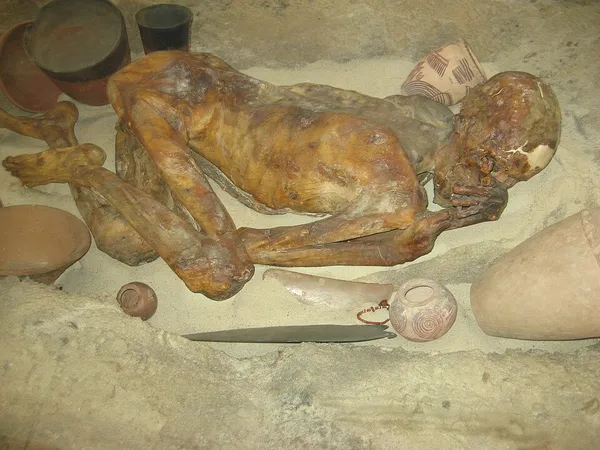
The Gebelein predynastic mummies are six naturally mummified human bodies from Gebelein in Upper Egypt, dating to the Late Predynastic period of Ancient Egypt. The best known of the group, EA 32751, is dated to Naqada II, c. 3400 BC, with a calibrated radiocarbon range of 3341–3017 BC at 95.4% probability. The bodies were excavated in 1896 by Wallis Budge, then Keeper of Egyptian and Assyrian Antiquities at the British Museum, from shallow sand graves at Baḥr Bila Mâ, on the eastern slopes of the northernmost hill at Gebelein. They were acquired by the British Museum in 1900. Two of the bodies are identified as male and one as female; the sex of the others is uncertain. Some grave goods were documented at the time of excavation as "pots and flints", but they were not acquired by the British Museum and their later whereabouts are unknown. Three of the bodies retain coverings or wrappings of different kinds, including basketry, linen, wicker, fur, and bandages. The bodies were buried in flexed positions, generally lying on their left sides. The first body excavated, EA 32751, has been on public display in the British Museum since 1901. The museum's current display places it in a reconstructed sand grave in Room 64, case 15; the object record describes ginger-coloured hair on the scalp and a penetrating wound to the upper left back. Infrared imaging published in 2018 identified figural tattoos on EA 32751 and on the female body EA 32752, making them among the earliest known figurative tattoos preserved on human skin.
Also on this shelf
Isurium Brigantum.
Angkor Borei and Phnom Da.
See also
Uncatalogued shelfText from Wikipedia; plate via Wikimedia Commons. Text CC BY-SA 4.0; plate freely licensed (see Commons). Source record. Images and catalogue data are reproduced from open-access collections.