Ancient World
Ancient Near East
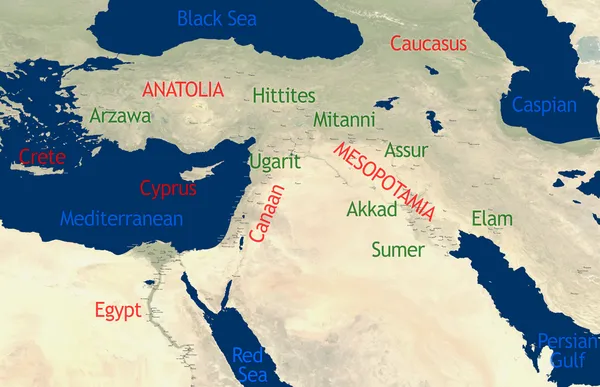
The ancient Near East was home to many cradles of civilization, spanning Ancient Mesopotamia, the ancient Levant, ancient Egypt, ancient Elam, ancient Anatolia or Asia Minor, the ancient South Caucasus and Armenian highlands, and ancient Northern Arabia (including Dilmun). It is generally not considered to include Pre-Islamic Arabia as a whole, the ancient Berbers, or ancient Nubia, though it is sometimes classified as encompassing ancient Iran, ancient Cyprus, Ancient Carthage, and the Aegean civilization. Due to their subject matter and scope, ancient Near East studies and Near Eastern archaeology, including the subfields of Assyriology and Egyptology, are among the most prominent research fields in ancient history. Other fields include Classics, Classical archaeology, biblical studies, biblical archaeology, Jewish studies, Christian studies, Iranology, Sinology, and Indology, some of which overlap with them. Historically, the Near East denoted an area roughly encompassing central West Asia and Egypt, having been focused on the lands between Greece in the west, Iran in the east, the Caucasus in the north, and Arabia in the south. It therefore largely corresponds with the central core area of the modern-day geopolitical concept of the Middle East.
Also on this shelf
Garni Temple.
Emporio, Chios.
See also
Uncatalogued shelfText from Wikipedia; plate via Wikimedia Commons. Text CC BY-SA 4.0; plate freely licensed (see Commons). Source record. Images and catalogue data are reproduced from open-access collections.