Ancient World
Hermes and the Infant Dionysus
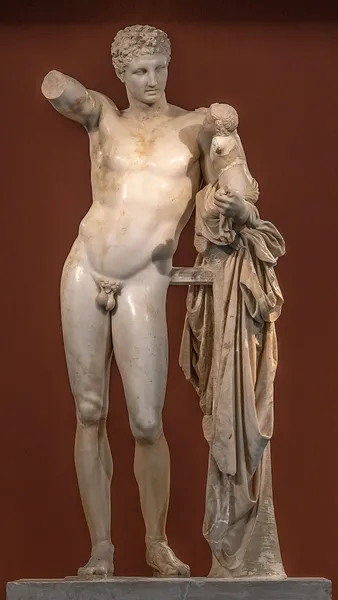
Hermes and the Infant Dionysus, also known as the Hermes of Praxiteles or the Hermes of Olympia, is an ancient Greek sculpture of Hermes and the infant Dionysus discovered in 1877 in the ruins of the Temple of Hera, Olympia, in Greece. It is displayed at the Archaeological Museum of Olympia. It is traditionally attributed to Praxiteles and dated to the 4th century BC, based on a remark by the 2nd century Greek traveller Pausanias, and has made a major contribution to the definition of Praxitelean style. Its attribution is, however, the object of fierce controversy among art historians. The sculpture is unlikely to have been one of Praxiteles' famous works, as no ancient replicas of it have been identified. The documentary evidence associating the work with Praxiteles is based on a passing mention by the 2nd century AD traveller Pausanias.
Also on this shelf
Code of Hammurabi.
First Jewish–Roman War.
See also
Uncatalogued shelfText from Wikipedia; plate via Wikimedia Commons. Text CC BY-SA 4.0; plate freely licensed (see Commons). Source record. Images and catalogue data are reproduced from open-access collections.