Ancient World
Ancient Macedonians
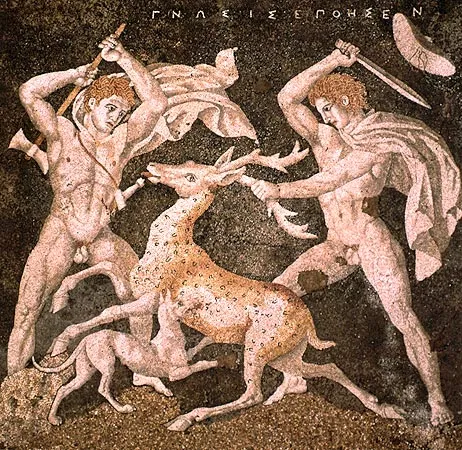
The Macedonians (Ancient Greek: Μακεδόνες, romanized: Makedónes) were an ancient tribe that lived on the alluvial plain around the rivers Haliacmon and lower Axios in the northeastern part of mainland Greece. Essentially an ancient Greek people, they established the kingdom of Macedon ruled from Aigai by the Argeads, and gradually expanded from their homeland along the Haliacmon valley on the northern edge of the Greek world, absorbing or driving out neighbouring non-Greek tribes, primarily Thracian and Illyrian. They spoke Ancient Macedonian, which is usually classified as a dialect of Northwest Greek, and occasionally as a dialect of Aeolic Greek or as a distinct Hellenic language (i.e. a sister language of Greek). However, the prestige language of Macedon during the Classical era was Attic Greek, replaced by Koine Greek during the Hellenistic era. Their religious beliefs mirrored those of other Greeks, following the main deities of the Greek pantheon, although the Macedonians continued Archaic burial practices that had ceased in other parts of Greece after the 6th century BC. Aside from the monarchy, the core of Macedonian society was its nobility. Similar to the aristocracy of neighboring Thessaly, their wealth was largely built on herding horses and cattle. Although composed of various clans, the kingdom of Macedon, established around the 7th century BC, is mostly associated with the Argead dynasty and the tribe named after it. The dynasty, also known as the Temenid dynasty, was allegedly founded by Perdiccas I, descendant of the legendary Temenus of Argos. Traditionally ruled by independent families, the Macedonians seem to have accepted Argead rule by the time of Alexander I (r. 498 – 454 BC). Under Philip II (r. 359 – 336 BC) ruling from Pella, the Macedonians are credited with numerous military innovations, which enlarged their territory and increased their control over other areas extending into Thrace. This consolidation of territory allowed for the exploits of Alexander the Great (r. 336 – 323 BC), the conquest of the Achaemenid Empire, the establishment of the diadochi successor states, and the inauguration of the Hellenistic period in West Asia, Greece, and the broader Mediterranean world.
Also on this shelf
Ancient Celtic music.
Archaeology of North Korea.
See also
Uncatalogued shelfText from Wikipedia; plate via Wikimedia Commons. Text CC BY-SA 4.0; plate freely licensed (see Commons). Source record. Images and catalogue data are reproduced from open-access collections.