Ancient World
Discovery of the tomb of Tutankhamun
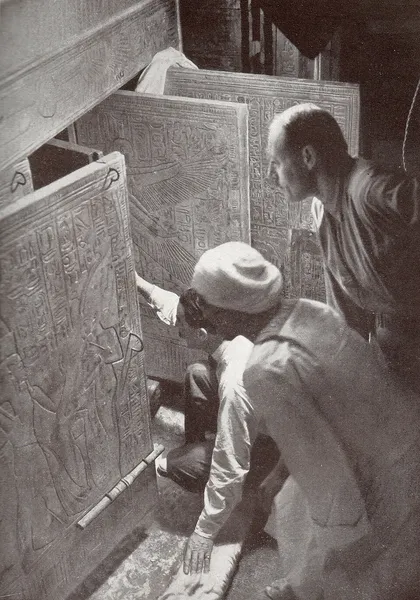
The tomb of Tutankhamun was discovered in the Valley of the Kings in 1922 by excavators led by the Egyptologist Howard Carter, more than 3,300 years after Tutankhamun's death and burial. Whereas the tombs of most pharaohs were plundered by graverobbers in ancient times, Tutankhamun's tomb was hidden by debris for most of its existence and therefore not extensively robbed. It thus became the only known near-intact royal burial from ancient Egypt. The tomb was opened beginning on 4 November 1922 during an excavation by Carter and his patron, the 5th Earl of Carnarvon. The burial consisted of more than five thousand objects, many of which were in a highly fragile state, so conserving the burial goods for removal from the tomb required an unprecedented effort. The opulence of the burial goods inspired a media frenzy and popularised ancient Egyptian-inspired designs with the Western public. To the Egyptians, who had recently become partially independent of British rule, the tomb became a symbol of national pride, strengthening Pharaonism, a nationalist ideology that emphasised modern Egypt's ties to the ancient civilisation, and creating friction between Egyptians and the British-led excavation team. The publicity surrounding the excavation intensified when Carnarvon died of an infection, giving rise to speculation that his death and other misfortunes connected with the tomb were the result of an ancient curse. After Carnarvon's death, tensions arose between Carter and the Egyptian government over who should control access to the tomb. In early 1924, Carter stopped work in protest, beginning a dispute that lasted until the end of the year. Under the agreement that resolved the dispute, the artefacts from the tomb would not be divided between the government and the dig's sponsors, as was standard practice in previous Egyptological digs, and most of the tomb's contents went to the Egyptian Museum in Cairo. In later seasons media attention waned, apart from coverage of the removal of Tutankhamun's mummy from its coffin in 1925. The last of the burial goods were conserved and shipped to Cairo in 1932. The tomb's discovery did not reveal as much about the history of Tutankhamun's time as Egyptologists had initially hoped, but it established the length of his reign and gave clues about the end of the Amarna Period, which preceded his reign.
Also on this shelf
Bell.
Julliberrie's Grave.
See also
Uncatalogued shelfText from Wikipedia; plate via Wikimedia Commons. Text CC BY-SA 4.0; plate freely licensed (see Commons). Source record. Images and catalogue data are reproduced from open-access collections.