Ancient World
Ancient Greek temple
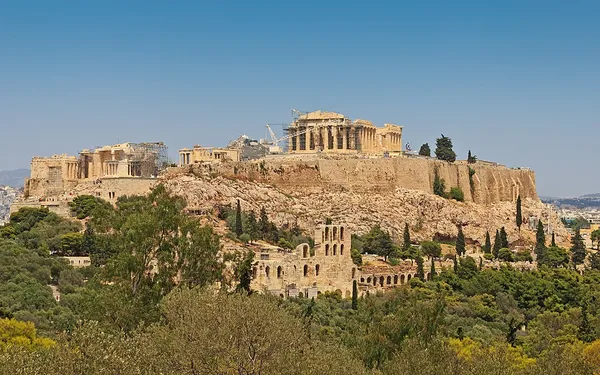
Greek temples (Ancient Greek: ναός, romanized: nāós, lit. 'dwelling', semantically distinct from Latin templum, "temple") were structures built to house deity statues within Greek sanctuaries in ancient Greek religion. The temple interiors did not serve as meeting places, since the sacrifices and rituals dedicated to the deity took place outside them, within the wider precinct of the sanctuary, which might be large. Temples were frequently used to store votive offerings. They are the most important and most widespread surviving building type in Greek architecture. In the Hellenistic kingdoms of Southwest Asia and of North Africa, buildings erected to fulfill the functions of a temple often continued to follow the local traditions. Even where a Greek influence is visible, such structures are not normally considered as Greek temples. This applies, for example, to the Graeco-Parthian and Bactrian temples, or to the Ptolemaic examples, which follow Egyptian tradition. Most Greek temples were oriented astronomically. Between the 9th century BC and the 6th century BC, the ancient Greek temples developed from the small mud brick structures into double-porched monumental "peripteral" buildings with colonnade on all sides, often reaching more than 20 metres in height (not including the roof). Stylistically, they were governed by the regionally specific architectural orders. Whereas the distinction was originally between the Doric and Ionic orders, a third alternative arose in late 3rd century with the Corinthian order. A multitude of different ground plans were developed, each of which could be combined with the superstructure in the different orders. Temples would be destroyed due to warfare in the Greek World or from lack of repairs. Some of these temples such as the temple of Poseidon Soter (The Savior) would be rebuilt outside of Athens after the defeat of the Persian Empire in 449. From the 3rd century onward, the construction of large temples became less common; after a short 2nd century BC flourish, it ceased nearly entirely in the 1st century BC.
Also on this shelf
Cahokia.
Jale İnan.
See also
Uncatalogued shelfText from Wikipedia; plate via Wikimedia Commons. Text CC BY-SA 4.0; plate freely licensed (see Commons). Source record. Images and catalogue data are reproduced from open-access collections.