Ancient World
Cheddar Man
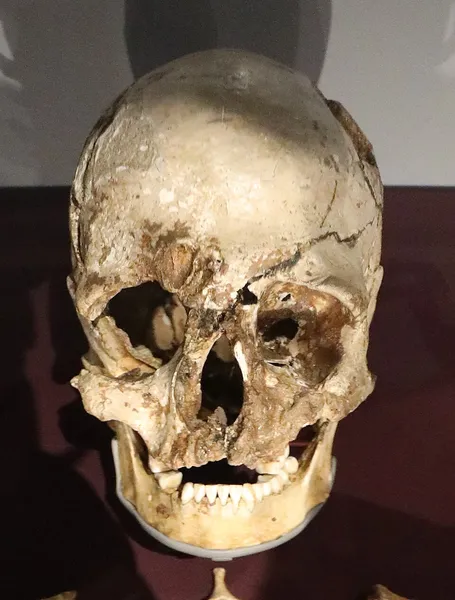
Cheddar Man is the name given to the nearly complete skeleton of a Mesolithic-era hunter-gatherer discovered in December 1903 in Gough's Cave, in Cheddar Gorge, Somerset, England. He lived around 8300 BC, approximately 10,300 years ago, and probably died in his early twenties. His remains constitute the oldest nearly complete human skeleton found in Great Britain. The skeleton was uncovered during drainage work near the cave entrance. Its position has been interpreted as evidence of a deliberate burial with the limbs bent, although the circumstances of deposition remain debated. His cause of death is unknown. Skull damage once considered evidence of fatal injuries is now thought more likely to have occurred after death, while a lesion above his right eye socket suggests a possible bone infection. Ancient DNA analysis indicates that he belonged to the Western European hunter-gatherer population. Genetic evidence suggests that he most likely had blue-green eyes, dark brown or black hair, and dark or dark-to-black skin, although these predictions are limited by incomplete genetic data. He lacked the genetic adaptation associated with the ability to digest milk in adulthood. His ancestry and reconstructed appearance have attracted widespread public attention and debate about British prehistory, race and national identity. His skeleton is displayed in the Human Evolution Gallery at the Natural History Museum in London, on loan from the Longleat Estate. Beside it is a facial reconstruction created in 2018 by Dutch artists Adrie and Alfons Kennis using skull scans and genetic evidence.
Also on this shelf
Beit She'an.
Amos Frumkin.
See also
Uncatalogued shelfText from Wikipedia; plate via Wikimedia Commons. Text CC BY-SA 4.0; plate freely licensed (see Commons). Source record. Images and catalogue data are reproduced from open-access collections.