Ancient World
History of Seville
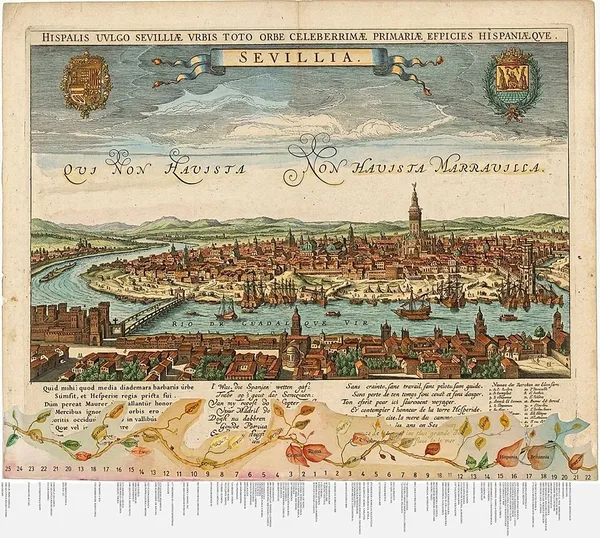
Seville has been one of the most important cities in the Iberian Peninsula since ancient times; the first settlers of the site have been identified with the Tartessian culture. The destruction of their settlement is attributed to the Carthaginians, giving way to the emergence of the Roman city of Hispalis, built very near the Roman colony of Itálica (now Santiponce), which was only 9 km northwest of present-day Seville. Itálica, the birthplace of the Roman emperors Trajan and Hadrian, was founded in 206–205 BC. Itálica is well preserved and gives an impression of how Hispalis may have looked in the later Roman period. Its ruins are now an important tourist attraction. Under the rule of the Visigothic Kingdom, Hispalis housed the royal court on some occasions. In al-Andalus (Muslim Spain) the city was first the seat of a kūra (Spanish: cora), or territory, of the Caliphate of Córdoba, then made capital of the Taifa of Seville (Arabic: طائفة أشبيليّة, Ta'ifa Ishbiliya), which was incorporated into the Christian Kingdom of Castile under Ferdinand III, who was first to be interred in the cathedral. After the Reconquista, Seville was resettled by the Castilian aristocracy; as capital of the kingdom it was one of the Spanish cities with a vote in the Castilian Cortes, and on numerous occasions served as the seat of the itinerant court. The Late Middle Ages found the city, its port, and its colony of active Genoese merchants in a peripheral but nonetheless important position in European international trade, while its economy suffered severe demographic and social shocks such as the Black Death of 1348 and the anti-Jewish revolt of 1391. After the discovery of the Americas, Seville became the economic centre of the Spanish Empire as its port monopolised the trans-oceanic trade and the Casa de Contratación (House of Trade) wielded its power, opening a Golden Age of arts and letters.
Also on this shelf
Archaeology of the Bar Kokhba Revolt.
Castlerigg stone circle.
See also
Uncatalogued shelfText from Wikipedia; plate via Wikimedia Commons. Text CC BY-SA 4.0; plate freely licensed (see Commons). Source record. Images and catalogue data are reproduced from open-access collections.