Ancient World
Ancient Egyptian race controversy
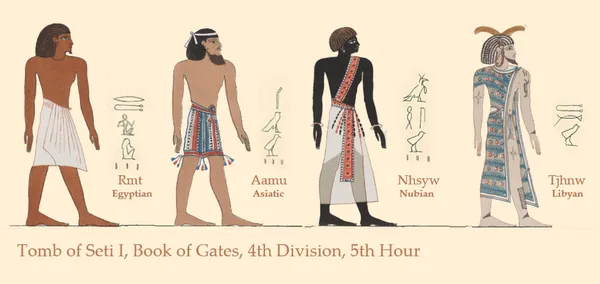
The question of the race of the people of ancient Egypt was raised historically as a product of the early racial concepts of the 18th and 19th centuries, and was linked to models of racial hierarchy primarily based on craniometry and anthropometry. A variety of views circulated about the racial identity of the Egyptians and the source of their culture. Some scholars argued that ancient Egyptian culture was influenced by other Afroasiatic-speaking populations in North Africa, the Horn of Africa, or West Asia, while others pointed to influences from various Nubian groups or populations in Europe. In more recent times, some writers continued to challenge the mainstream view, some focusing on questioning the race of specific notable individuals, such as the pharaoh represented in the Great Sphinx of Giza, the native Egyptian pharaoh Tutankhamun, the Egyptian queen Tiye, and the Greek Ptolemaic queen Cleopatra VII. Mainstream Western scholars reject the notion that Egypt was a "white" or "black" civilization; They maintain that applying modern notions of black or white races to ancient Egypt is anachronistic. In addition, scholars reject the notion—implicit in a black or white Egypt hypothesis—that ancient Egypt was racially homogeneous; instead, skin colour varied between the peoples of Lower Egypt, Upper Egypt, and Nubia, who rose to power in various eras of ancient Egypt. Within Egyptian history, despite multiple foreign invasions, the demographics were not shifted substantially by large migrations. Other scholars have suggested there may have been a gradual period of demographic change from Syria via the eastern Delta region. International scholarship reflected in the General History of Africa, a multi-volume historical project of UNESCO, have expressed a comparable position. A majority of the scholars that contributed to the Volume II edition (1981) considered Egypt an indigenous African civilisation with a mixed population that originated largely in the Sahara and featured a variety of skin colours from north and south of the Saharan region. In the view of Egyptian scholar and featured editor Gamal Mokhtar, Upper Egypt and Nubia held "similar ethnic composition" with comparable material cultures. An updated Volume IX publication launched in 2025 maintained that Egypt had both African and Eurasian populations.
Also on this shelf
Clove.
Baalbek Stones.
See also
Uncatalogued shelfText from Wikipedia; plate via Wikimedia Commons. Text CC BY-SA 4.0; plate freely licensed (see Commons). Source record. Images and catalogue data are reproduced from open-access collections.