Ancient World
Bactria–Margiana Archaeological Complex
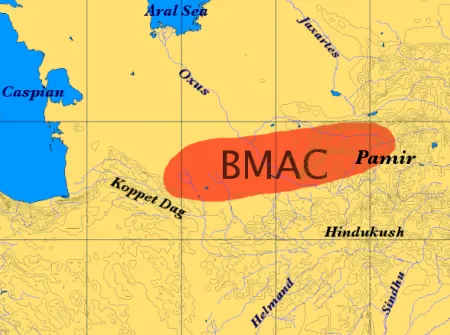
The Bactria–Margiana Archaeological Complex (BMAC) is the modern archaeological designation for a particular Middle Bronze Age civilisation of southern Central Asia in regions around the Caspian Sea and Aral Sea. This civilization is also known as the Oxus Civilization. The civilization thrived between about 2500 BCE and 1700 BCE, though there is debate about details and interpretation of data. Although commonly referred to as the “Oxus civilization” and formally designated as the “Bactria–Margiana Archaeological Complex” (BMAC), recent studies have questioned the geographic adequacy of these terms. While the traditional labels emphasise the concentration of major urban sites in Margiana and northern Bactria, new archaeological surveys and excavations show that the cultural core of this Bronze Age complex was considerably broader. Significant sites have been documented across northeastern Iran, within the historical region of Greater Khorasan, including newly excavated settlements such as Tepe Chalow, Kalat-e Yavar, and Shahrak-e Firouzeh, along with numerous surveyed locations exhibiting characteristic BMAC material culture. On the basis of this wider distribution—extending from Sabzevar and Nishapur to the Murghab delta and Tajikistan—some scholars (e.g., Biscione & Vahdati) argue that “BMAC” and “Oxus Civilization” are overly restrictive, either overlooking formative areas or limiting the phenomenon to Bactria and Margiana.". Because the full spread of sites corresponds closely to the historical expanse of Greater Khorasan and reflects long-term cultural continuity into the Iron Age and later periods, these authors propose the broader term “Greater Khorasan Civilization” (GKC) for this archaeological complex. There are a few later (c. 1950–1450 BC) sites in northern Bactria, today southern Uzbekistan, but they are mostly graveyards belonging to the BMAC-related Sapalli culture. A single BMAC site, known as Dashli, lies in southern Bactria, current territory of northern Afghanistan. Sites found further east, in southwestern Tajikistan, though contemporary with the main BMAC sites in Margiana, are only graveyards, with no urban developments associated with them. The civilisation was named BMAC by the Soviet archaeologist Viktor Sarianidi in 1976 when he was excavating in northern Afghanistan (1969–1979).
Also on this shelf
Assyrian lion weights.
Cave of Horrors.
See also
Uncatalogued shelfText from Wikipedia; plate via Wikimedia Commons. Text CC BY-SA 4.0; plate freely licensed (see Commons). Source record. Images and catalogue data are reproduced from open-access collections.