Ancient World
Carnac stones
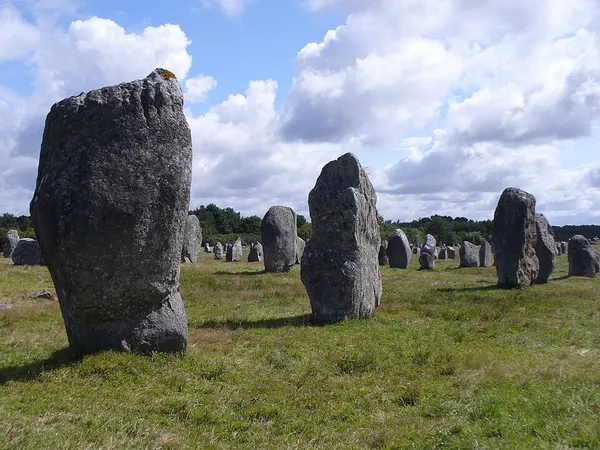
The Carnac stones (Breton: Steudadoù Karnag) are an exceptionally dense collection of megalithic sites near the south coast of Brittany in northwestern France, consisting of stone alignments (rows), dolmens (stone tombs), tumuli (burial mounds), and single menhirs. More than 3,000 prehistoric standing stones were hewn from local granite and erected by the pre-Celtic people of Brittany and form the largest such collection in the world. Most of the stones are within the Breton municipality of Carnac, but some to the east are within neighboring La Trinité-sur-Mer. Numerous megaliths and tumuli are also found in the surrounding areas, such as at Locmariaquer and Arzon, and on islands in the Gulf of Morbihan (e.g. Gavrinis). The stones were erected at some stage during the Neolithic period, probably around 3300 BC, but some may date to as early as 4500 BC. Although the stones date from 4500–3300 BC, modern beliefs associated them with first century AD Roman and later Christian occupations. A Christian legend associated with the stones held that they were pagan soldiers in pursuit of Pope Cornelius when he turned them to stone. Brittany has its own local versions of the Arthurian cycle. Local tradition similarly claims that the reason they stand in such perfectly straight lines is that they are a Roman legion turned to stone by Merlin the Wizard. In recent centuries, many of the sites have been neglected, with reports of dolmens being used as sheep shelters, chicken sheds, or even ovens. Even more commonly, stones have been removed to make way for roads, or as building materials. The continuing management of the sites remains a controversial topic. According to Neil Oliver's BBC documentary A History of Ancient Britain, the alignments were built by hunter-gatherer people ("These weren't erected by Neolithic farmers, but by Mesolithic hunters"). That would place them in a different category from Stonehenge in England, which has been claimed to be the work of Early European Farmers. The question of which people Carnac stones are to be attributed to is still debated.
Also on this shelf
Dan Warner.
Cyclades.
See also
Uncatalogued shelfText from Wikipedia; plate via Wikimedia Commons. Text CC BY-SA 4.0; plate freely licensed (see Commons). Source record. Images and catalogue data are reproduced from open-access collections.