Ancient World
Erlitou
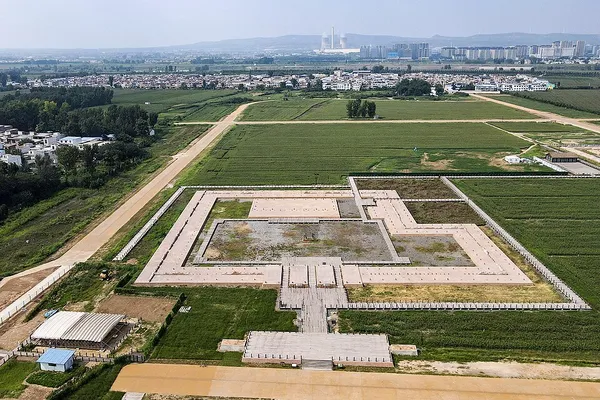
Erlitou (Chinese: 二里头; pinyin: Èrlǐtou), also known as Yanshi Erlitou, is a Chinese archaeological site in the Yiluo Basin of Yanshi District, Luoyang, Henan. Discovered by survey teams led by archaeologist Xu Xusheng in 1959, it was initially identified as Bo, the first capital of the Shang dynasty. Some Chinese archaeologists later recognized it as the capital of the Xia—a dynasty of debated existence. A center of early Bronze Age China, Erlitou is the type site and largest settlement of the eponymous Erlitou culture. More limited occupation has been found from the earlier Yangshao and Longshan cultures and the later Erligang culture. The site was the paramount settlement of a polity which spread across the Yiluo Basin and adjacent portions of the Mount Song region. The site lies south of what later is the Luo River; during its period of occupation, the settlement was on the river's northern bank. An initial Neolithic period of occupation, which saw settlements at the site, lasted from c. 3500–2600 BCE. After centuries of vacancy, a settlement emerged around 1860 BCE, and later became the largest settlement in the Yiluo Basin, possibly attracting waves of migrants. At its peak, it reached a population of around 24,000 residents and an area of around 300 hectares (740 acres). Centered around a palatial complex surrounded by rammed earth walls, the city became a center of bronze casting, pioneering piece-mold casting and the production of bronze ritual vessels. Turquoise and jade goods were also produced at the site, including ritual artifacts such as ceremonial weapons and turquoise-inlaid bronze plaques. Outside of the palatial complex, the settlement consists mostly of semi-subterranean houses intermixed with graves and tombs, mostly underlying houses, courtyards, and roads. There are no formal cemeteries, and tombs were placed sporadically and built over. The site contains the remains of the earliest known road network in China. A set of wagon tracks has been found on these roads. In the later era, the site partially underlies three villages, which continue construction projects and development atop the site. Probing excavations are made by the Institute of Archaeology prior to development, while at times construction is done without archaeological involvement.
Also on this shelf
Archaeological site of Carthage.
Fiesole.
See also
Uncatalogued shelfText from Wikipedia; plate via Wikimedia Commons. Text CC BY-SA 4.0; plate freely licensed (see Commons). Source record. Images and catalogue data are reproduced from open-access collections.