Ancient World
History of Timbuktu
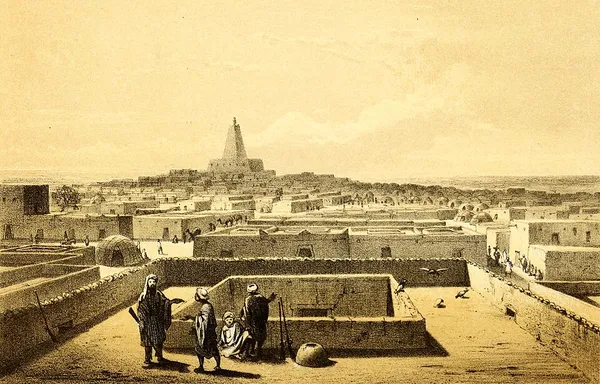
Starting out as a seasonal Tuareg or Berber settlement in the late 11th or early 12th century AD, Timbuktu became a permanent settlement either in the 13th or early 14th century. After a shift in trading routes in the later 14th century, the town flourished from the trade in salt, gold, ivory and slaves from several towns and states such as Begho of Bonoman, Sijilmassa, and other Saharan cities. It became part of the Mali Empire early in the 14th century when it was annexed by Mansa Musa. When Ibn Battuta visited Timbuktu in 1353 he noted that most of the inhabitants were Massufa Berbers, despite the town being under Malian rule. In the first half of the 15th century the Tuareg tribes took control of the city for a short period until the expanding Songhai Empire absorbed the city in 1468. The Moroccan army defeated the Songhai in 1591, and made Timbuktu, rather than Gao, their capital. The invaders established a new ruling class, the Arma, who after 1612 became virtually independent of Morocco. However, the golden age of the city was over, in which it was a major learning and cultural center in the Songhai empire, and it entered a long period of decline. Different tribes governed until the French took over in 1893, a situation that lasted until it became part of the current Republic of Mali in 1960. Presently, Timbuktu is impoverished and suffers from desertification. In its Golden Age in the 16th century, the town's numerous Islamic scholars and extensive trading network made possible an important book trade. This established Timbuktu as a renowned scholarly centre, with cultural hubs that included Sankoré Madrasa. The Andalusi author Leo Africanus visited Timbuktu in this period (in 1512) and gave a description of the town. Over two and half centuries later (in 1780) another notable account was given by the Moroccan author Shabeni, who described Timbuktu at a very different point in its history. These stories fueled speculation in Europe, where the city's reputation shifted from being extremely rich to being mysterious. This reputation overshadows the town itself in modern times, to the point where it is best known in Western culture as an expression for a distant or outlandish place.
Also on this shelf
Cladh Hallan.
Arthur Evans.
See also
Uncatalogued shelfText from Wikipedia; plate via Wikimedia Commons. Text CC BY-SA 4.0; plate freely licensed (see Commons). Source record. Images and catalogue data are reproduced from open-access collections.